As the 2025 reporting season approaches, foreign private issuers (FPIs) are navigating a landscape shaped by evolving SEC mandates, global climate regulations, and heightened investor scrutiny. Drawing on our experience working closely with issuers and their advisors, many SEC filers are taking proactive steps to strengthen disclosure quality, streamline structured data compliance, and align with emerging best practices.
Below, we explore the key significant developments and practical considerations for FPIs preparing their next Form 20-F.
Insider Trading Policy Disclosure – Item 16J
One of the most notable changes for 2025 filings is the requirement to disclose insider trading policies under Item 16J of Form 20-F. This stems from SEC amendments adopted in December 2022 under Regulation S-K Item 408(b). FPIs are now expected to:
State whether they maintain insider trading policies and procedures.
Provide a brief description or explain if no such policy exists.
File the policy as Exhibit 11 to Form 20-F.
Tag the disclosure in Inline XBRL.
Read more on the SEC website: Insider Trading Arrangements and Related Disclosures
Cybersecurity Disclosure Enhancements
Under the SEC’s Cybersecurity Risk Management, Strategy, Governance, and Incident Disclosure rule (finalised July 2023), FPIs are advised to review their approach to cyber risk reporting. Key expectations include:
Describing risk management processes and board oversight.
Explaining how cyber risk integrates into enterprise risk management.
Disclosing material impacts of cyber incidents.
Addressing oversight of third-party service providers.
Read more on the SEC website: Cybersecurity Risk Management Rule Summary
AI-Related Disclosures – Avoiding ‘AI Washing’
The SEC has signalled growing concern over misleading statements about artificial intelligence. FPIs are encouraged to:
Define AI use clearly and avoid generic language.
Provide tailored disclosures on material risks and governance.
Ensure statements are supported by a reasonable basis.
Read more: SEC Reporting Update: Highlights of trends in 2025 SEC staff comment letters
Climate and ESG Reporting – California SB 253 and SB 261
Federal climate disclosure rules remain in limbo following litigation in the Eighth Circuit, which in September 2025 ordered the SEC to decide whether to defend, modify, or rescind its rules. With no clear timeline and climate regulation deprioritised at the federal level, attention has shifted to state and international frameworks. California’s SB 253 (Climate Corporate Data Accountability Act) and SB 261 (Climate-Related Financial Risk Act) are particularly relevant for FPIs with U.S. subsidiaries doing business in California:
• SB 253 applies to entities with $1 billion+ global revenue and requires annual disclosure of Scope 1 and Scope 2 emissions starting in 2026, with Scope 3 reporting phased in later.
• SB 261 applies to entities with $500 million+ global revenue and mandates biennial disclosure of climate-related financial risks aligned with TCFD. Enforcement is currently paused following a Ninth Circuit injunction, but companies may still choose to prepare voluntary reports.
Even if headquartered outside the U.S., FPIs with U.S. subsidiaries or operations in California should assess applicability under SB 253 and SB 261. In-scope companies are advised to monitor CARB guidance and litigation outcomes, and ensure consistency between California reporting and SEC filings, including Form 20-F.
Structured Data and Inline XBRL
Ensuring accuracy in structured data remains a key focus for regulators. The SEC requires that all new disclosures, such as insider trading policies, cybersecurity governance, and clawback provisions, must be tagged in Inline XBRL. This is not just a technical requirement; tagging errors have increasingly been cited in enforcement actions.
DFIN’s experience suggests that issuers are moving toward integrated drafting with iXBRL tagging embedded within workflows to ensure consistency between narrative and structured data. Maintaining one source of truth on a unified digital platform ensures disclosures are always current and consistently updated, while automated validation tools help reduce compliance risk and accelerate filing timelines, especially as disclosure complexity continues to increase.
Practical Steps for FPIs
Many of DFIN’s clients and partners are implementing these measures as they prepare for their 2025 Form 20-F annual report:
Drafting insider trading policy exhibits early and coordinating with legal teams to ensure readiness for Item 16J requirements.
Conducting gap analyses on cybersecurity and AI disclosures to confirm materiality and avoid generic or misleading statements.
Aligning climate reporting with California SB 253/261 and EU CSRD frameworks, anticipating investor expectations and global interoperability.
Validating Inline XBRL tagging for all new disclosure items, leveraging automation to reduce errors and accelerate filing timelines.
Establishing cross-functional governance to maintain consistency across filings, earnings calls, and investor communications.
Looking Ahead: 2026 and Beyond
The SEC’s Spring 2025 regulatory agenda signals a notable shift in priorities. Previous initiatives—such as human capital management and corporate board diversity disclosures—have been set aside. Instead, the Commission appears to be focusing on easing compliance burdens and facilitating capital formation.
Industry sources suggest that an ambitious deregulatory agenda is expected to take shape in 2026, with proposals aimed at rationalising disclosure practices, reducing complexity, and simplifying pathways for raising capital. For FPIs, this could translate into streamlined reporting requirements and greater flexibility in accessing global capital markets.
DFIN’s Role in Supporting FPIs Through 2026
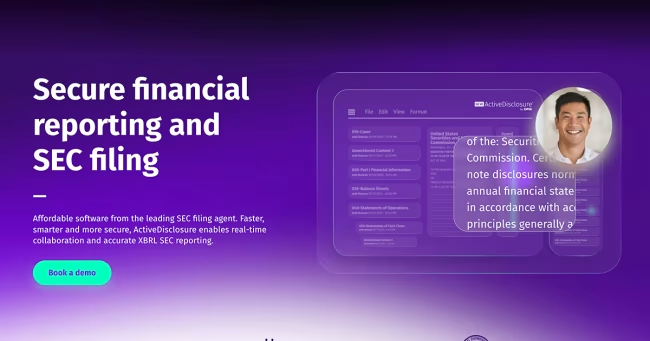
As disclosure requirements evolve and the SEC’s 2026 regulatory agenda begins to take shape, many FPIs are reassessing their reporting strategies to balance compliance with efficiency. DFIN’s ActiveDisclosure platform is designed to help issuers navigate this transition seamlessly—offering integrated drafting, collaboration, and Inline XBRL tagging within a single workflow.
By combining automation with expert support, DFIN ActiveDisclosure enables FPIs to reduce complexity, maintain accuracy, and adapt quickly to regulatory changes—whether aligning to disclosure standards or streamlining reporting workflows. DFIN remains committed to supporting FPIs on this journey, helping clients stay ahead of compliance requirements.
Click here to learn more about SEC Reporting with ActiveDisclosure, or get in touch today for further information about preparing your next 20-F or SEC filing.