Enterprise AI demands discipline, not experimentation

As artificial intelligence becomes embedded in enterprise workflows, expectations have shifted. Innovation is no longer measured by novelty alone; it is measured by trust. For organizations managing regulated data, intellectual property, and sensitive financial information, AI adoption must be grounded in security, privacy, and governance from the outset.
In our AI Insights Video Series, Floyd Strimling brings a pragmatic, enterprise-first perspective to how AI should be deployed in corporate environments. The focus is not on accelerating adoption for its own sake, but on ensuring that intelligence scales responsibly, without compromising the integrity of customer data or the systems that depend on it.
A Clear Boundary Around Customer Data
DFIN’s AI strategy begins with an unambiguous principle: customer data is never used to train models. That boundary is foundational. Instead of exposing sensitive information, secure techniques such as retrieval-augmented generation and contextual retrieval enable intelligence while keeping customer data isolated within segmented knowledge bases.
This approach ensures that insight is delivered without ingestion, reuse, or leakage—preserving control while still enabling efficiency. In an environment where lost intellectual property cannot be recovered, this distinction is critical.
Security Architecture Built for Enterprise Reality
Protecting data at scale requires more than policy; it requires architecture. DFIN’s AI capabilities are supported by a security framework designed for enterprise use, including encryption at rest and in transit, granular access controls, and a zero-trust model developed in close partnership with DFIN’s security teams.
As AI introduces new threat vectors, from prompt injection to unintended data exposure, the emphasis remains on mitigation, containment, and resilience. Customers retain the ability to opt in or out of specific capabilities based on their own security posture, reinforcing control rather than eroding it.
Subscribe to receive our latest content
Transparency as a Prerequisite for Trust
Trust is sustained through clarity. From Floyd’s perspective, transparency is treated as essential infrastructure, not a feature. Customer data remains the property of the customer, never repurposed for public models or external learning systems, and is handled with the same rigor expected of leading cloud and enterprise platforms.
This commitment aligns AI adoption with longstanding enterprise trust practices, ensuring that innovation strengthens confidence rather than introducing uncertainty.
Intelligence Designed to Solve Real Problems
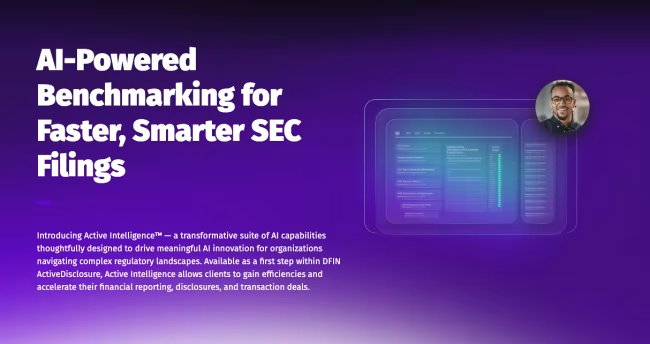
AI delivers value when it removes friction from real workflows. Active Intelligence within DFIN ActiveDisclosure reflects this principle in practice. Built directly from customer feedback, the capability allows teams to compare filings against peers, review current disclosures alongside prior versions, and surface inconsistencies in minutes instead of hours.
What once required significant manual effort can now be accomplished with speed and precision, without weakening governance or control. The result is efficiency that scales responsibly, supporting better decision-making rather than automation for its own sake.
Moving Beyond the AI Hype Cycle
Rather than chasing headlines, Floyd frames AI adoption as a long-term evolution, one that mirrors past technology cycles where lasting value emerged only after hype subsided. The focus shifts to practical use cases that integrate securely with existing enterprise systems, accelerate product development, and enhance human decision-making.
Looking ahead, this measured approach positions AI not as a disruptive force to be contained, but as an enabling capability, one that can responsibly shape innovation across industries, from financial services to bioscience and healthcare.
Confidence That Endures as Technology Evolves
Enterprise AI is not a race to adopt; it is a commitment to building trust that lasts. By anchoring intelligence in security, transparency, and customer control, organizations can unlock efficiency and insight without compromising the foundations that matter most.