Board reporting should help directors do one thing efficiently: make informed, confident decisions. But in many organizations, board packs have become longer, denser, and harder to interpret, filled with data that’s accurate, yet difficult to act quickly.
In today’s environment – where boards face increased regulatory scrutiny, market volatility, and expanded oversight responsibilities – this approach no longer works. Boards don’t need more information; they need sharper insight, clearer context, and faster answers.
Modern board reporting goes beyond static financial summaries. It combines financial performance, operational signals, and risk indicators into a concise, structured narrative that explains not just what happened, but what it means and what comes next.
Here are eight best practices to consider in your board reporting approach.
1. Design for Decision Making, Not Data Delivery
Effective board reports start with the end in mind: the decisions directors need to make. Rather than organizing content around internal functions or data sources, structure reports to highlight what’s changed, why it matters, and where guidance or approval is needed.
A consistent, repeatable format also helps directors quickly orient themselves, reducing time spent navigating the report and increasing time spent on discussion.
2. Lead With a Strong Executive Summary
The executive summary should distill the entire report into a clear, one-page narrative. It’s not a recap – it’s an interpretation.
This should focus on:
- Key performance highlights
- Material changes since the last meeting
- Variances versus plan and their drivers
- Top risks or opportunities
- Decisions or actions required
If a board member only reads this section, they should still grasp the company’s position and priorities.
3. Prioritize Clarity Over Complexity
Clarity is essential to effective governance. Reports filled with jargon, acronyms, or overly technical language slow comprehension and create unnecessary friction.
Use plain, direct language and clearly label insights. Replace vague section headers with statements that communicate meaning, for example, “Margin pressure driven by cost increases,” instead of simply “Margins.”
The goal is simple: make insights immediately understandable to every board member, regardless of background.
4. Use Visuals to Surface Insights Quickly
Well-designed visuals help directors identify trends, outliers, and key drivers at a glance. Charts should simplify, not decorate.
Focus on:
- Multi-period trend lines (e.g., quarterly performance)
- Variance waterfalls to show key drivers
- Highlighted exceptions or anomalies
- Forecast comparisons and scenarios
Where appropriate, interactive dashboards can add depth, but the core board report should remain focused and easy to scan.
5. Add Context That Connects to Strategy
Data alone doesn’t support decision making; context does. Each section of the report should interpret results and tie them back to strategic objectives.
Ask and answer:
- What changed this period?
- What caused the change?
- What are the implications for the upcoming quarters?
- What actions are being taken?
This forward-looking perspective helps boards move beyond reviewing performance to actively shaping outcomes.
6. Focus on the Metrics That Matter Most
Boards don’t need every metric – they need the ones that best reflect company performance, risk, and strategic progress.
A balanced set typically includes:
- Core financial metrics (revenue, profitability, cash flow)
- Operational indicators (efficiency, delivery, capacity)
- Customer metrics (retention, satisfaction, concentration)
- Risk and compliance signals
- Talent and organizational health
Including a short “signals to watch” section can also help directors anticipate emerging risks before they escalate.
7. Reinforce Accuracy, Consistency, and Trust
Accuracy is foundational to board confidence. Even small inconsistencies can slow meetings and erode trust in the data.
To strengthen reporting integrity:
- Standardize templates and definitions
- Use a single source of truth for key data
- Maintain version control and auditability
- Validate data before distribution
Consistency over time is just as important as accuracy – boards rely on comparability to understand trends and performance shifts.
8. Leverage Technology to Improve Efficiency and Oversight
Manual reporting processes, such as pulling data, updating slides, reconciling versions, are time-consuming and prone to error. Modern reporting tools streamline this work while improving control and visibility.
With the right technology, teams can:
- Automate data aggregation and updates
- Reduce spreadsheet sprawl and manual entry
- Enforce workflows and approvals
- Securely distribute materials with audit trails
AI is also starting to play a role in helping generate summaries or highlight variances, but should always be implemented with governance, transparency, and human oversight.
Elevating the Role of Board Reporting
At its best, board reporting transforms complexity into clarity. It shifts conversations from “What happened?” to “What should we do next?” – enabling faster, more strategic decisions.
Organizations that modernize their approach, by focusing on clarity, context, and controlled workflows, can reduce reporting burden, improve accuracy, and drive more meaningful board engagement. In a landscape where expectations continue to rise, effective board reporting is no longer just a routine exercise. It’s a critical enabler of strong governance and better business outcomes.
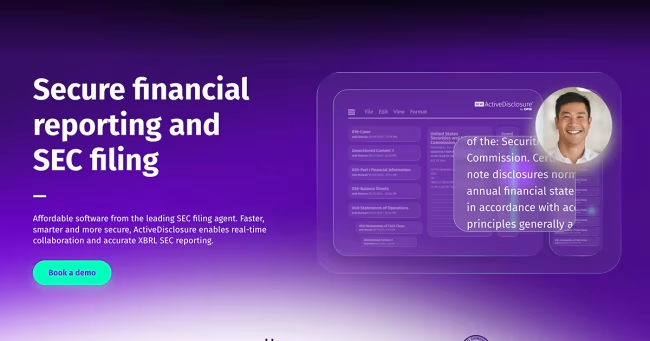
DFIN ActiveDisclosure simplifies and strengthens the board reporting process by centralizing data, automating workflows, and ensuring accuracy across every version of your report. With built-in controls, secure collaboration, and AI-enabled insights, teams can reduce manual effort while delivering clearer, more consistent reporting. The result is a more efficient process for creating board materials that empower faster, more confident decision making.