Financial reporting is no longer a static, compliance‑only exercise. As disclosure requirements grow more complex and scrutiny from regulators and investors intensifies, reporting teams are being asked to do more than ensure accuracy. They must demonstrate consistency, judgment, and an understanding of market expectations, often under tightening timelines.
This shift has elevated the role of peer benchmarking. What was once a manual analysis exercise has become a strategic capability: one that enables organizations to make smarter, faster, and more defensible disclosure decisions.
Financial Reporting Has Entered a New Era
The modern disclosure environment is defined by context. Investors and regulators increasingly evaluate companies relative to their peers, examining not only what is disclosed, but how and why. Accuracy remains table stakes, but credibility is now shaped by alignment with market norms, transparency in judgment, and consistency over time.
In this environment, reporting teams need more than historical precedent. They need clear visibility into how similar organizations are approaching disclosure, today, not after the fact.
The Limits of Traditional Peer Benchmarking
Most organizations agree that peer comparisons matter. The challenge is that traditional benchmarking methods are often manual, static, and disconnected from the actual reporting workflow.
Teams spend hours searching public filings, extracting language, and tracking changes across spreadsheets or PDFs. Insights are fragmented, difficult to validate, and frequently surface late in the reporting cycle, when revisions are costly and risk is already elevated. Instead of empowering proactive decisions, peer data becomes a reactive checkpoint.
As reporting timelines compress and disclosure topics expand, this approach introduces unnecessary inefficiency and risk.
Subscribe to receive our latest content
Peer Analysis as a Strategic Capability
Modern peer analysis goes well beyond side‑by‑side comparisons. When embedded into the reporting process, it becomes decision‑grade intelligence that provides insight into how disclosure practices are evolving across comparable companies and industries.
With real‑time access to peer data, teams can quickly assess whether they are over‑ or under‑disclosing, identify emerging trends before they become expectations, and evaluate how specific topics are being addressed across the market. This context transforms disclosure from guesswork into strategy, grounding judgment calls in demonstrable peer behavior rather than assumptions.
Turning Insight into Action with Active IntelligenceTM
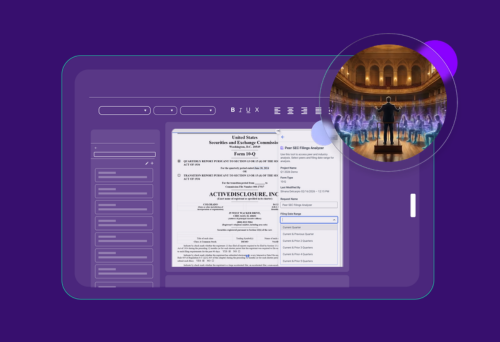
The greatest value of peer intelligence comes when insight is available early and applied directly within the drafting and review process. DFIN’s Active Intelligence Peer Analysis capabilities within ActiveDisclosureSM enable teams to identify gaps, inconsistencies, and outliers long before filings reach audit or regulatory review.
Early visibility reduces last‑minute changes, minimizes rework, and supports smoother collaboration with legal and audit partners. Instead of reacting to issues late in the cycle, teams can address them proactively, improving both efficiency and confidence. Here are the top 3 ways we’ve seen organizations benefit from using Peer Analysis:
-
Preserving Consistency and Institutional Knowledge
Disclosure decisions rarely exist in isolation. They span multiple reporting cycles, regulatory updates, and team changes. Peer intelligence helps organizations preserve institutional knowledge by maintaining consistent rationale for disclosure decisions over time.
This continuity reduces reliance on tribal knowledge, strengthens documentation and governance, and ensures that judgment calls remain explainable and defensible, even as regulations evolve or personnel change. Reporting becomes more repeatable, auditable, and resilient.
-
Aligning Stakeholders Around a Shared View
Disclosure decisions involve many stakeholders—finance, legal, compliance, auditors, and external counsel—each with distinct priorities. Peer intelligence improves alignment by creating a shared, objective reference point.
Rather than debating hypotheticals, teams can anchor discussions in real‑world peer behavior. This clarity leads to more productive review cycles, faster consensus, and stronger support for complex judgment calls, particularly as new regulations introduce interpretation risk.
-
Competitive Context Without Commoditization
Understanding how peers disclose does not mean forcing conformity. In fact, peer intelligence enables informed differentiation.
With visibility into the market baseline, companies can make intentional choices about where alignment strengthens credibility and where deviation supports a distinct narrative. This reduces the risk of standing out unintentionally while preserving flexibility to tell a compelling, authentic story.
The Future of Disclosure Is Intelligence‑Driven
As disclosure expands beyond financials into governance, risk, and emerging regulatory areas, reporting teams need more than tools that help them file. They need intelligence that helps them make informed decisions faster and with greater confidence.
Peer Analysis powered by DFIN Active Intelligence represents a fundamental shift from reactive compliance to proactive strategy. In today’s reporting landscape, the most effective filers aren’t just compliant. They’re informed, aligned, and prepared for what’s next. Get started today.