Cross-border transactions have always asked more of deal teams than domestic ones. A single acquisition can involve entities in three jurisdictions, advisors in five time zones, and a diligence file that arrives in several languages and a dozen document formats. The work is not conceptually harder than a domestic deal. It is simply larger, slower, and more fragmented — and that fragmentation is where confidence tends to erode.
Buyers, sellers, and their advisors are now applying AI to precisely that friction. Not to make judgment calls, but to compress the distance between "we received the documents" and "we understand what is in them."
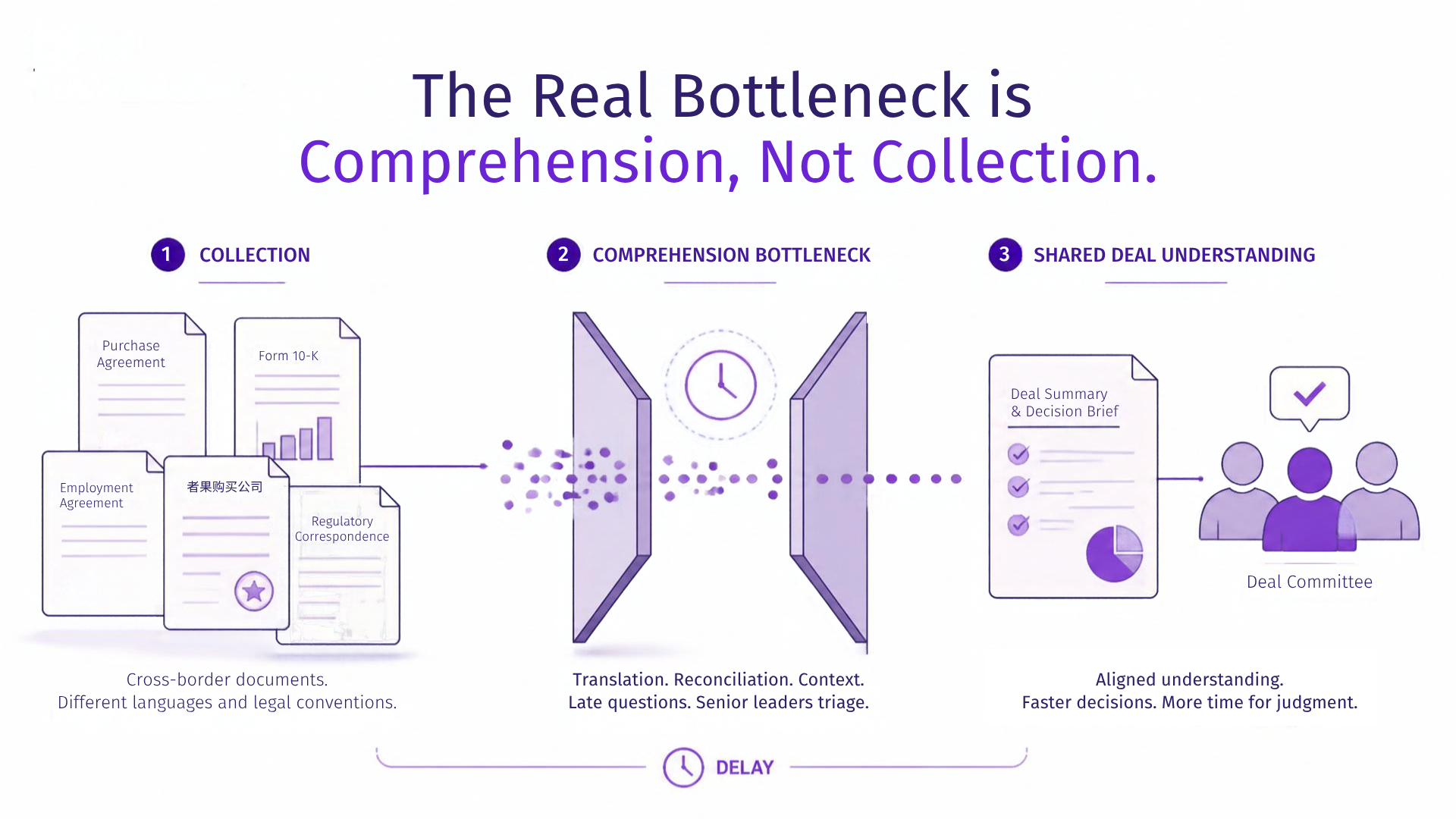
The Real Bottleneck is Comprehension, Not Collection
Most deal teams are good at gathering information. Requests go out, folders fill up, trackers get updated. The bottleneck sits one step later: turning thousands of pages of contracts, filings, employment agreements, and regulatory correspondence into a shared understanding a deal committee can act on.
In a cross-border process, that step carries extra weight. Documents may be drafted in the local language and under local legal convention. Reviewers who read the language may not sit on the deal team. Reviewers who own the commercial question may be waiting on a translation before they can weigh in. Meanwhile, the timeline does not move.
The consequence is rarely a dramatic failure. It is a quieter cost: decisions made later than they could have been, questions raised in week six that could have surfaced in week two, and senior leaders spending time on triage rather than on judgment.
How AI is Changing the Nature of Work
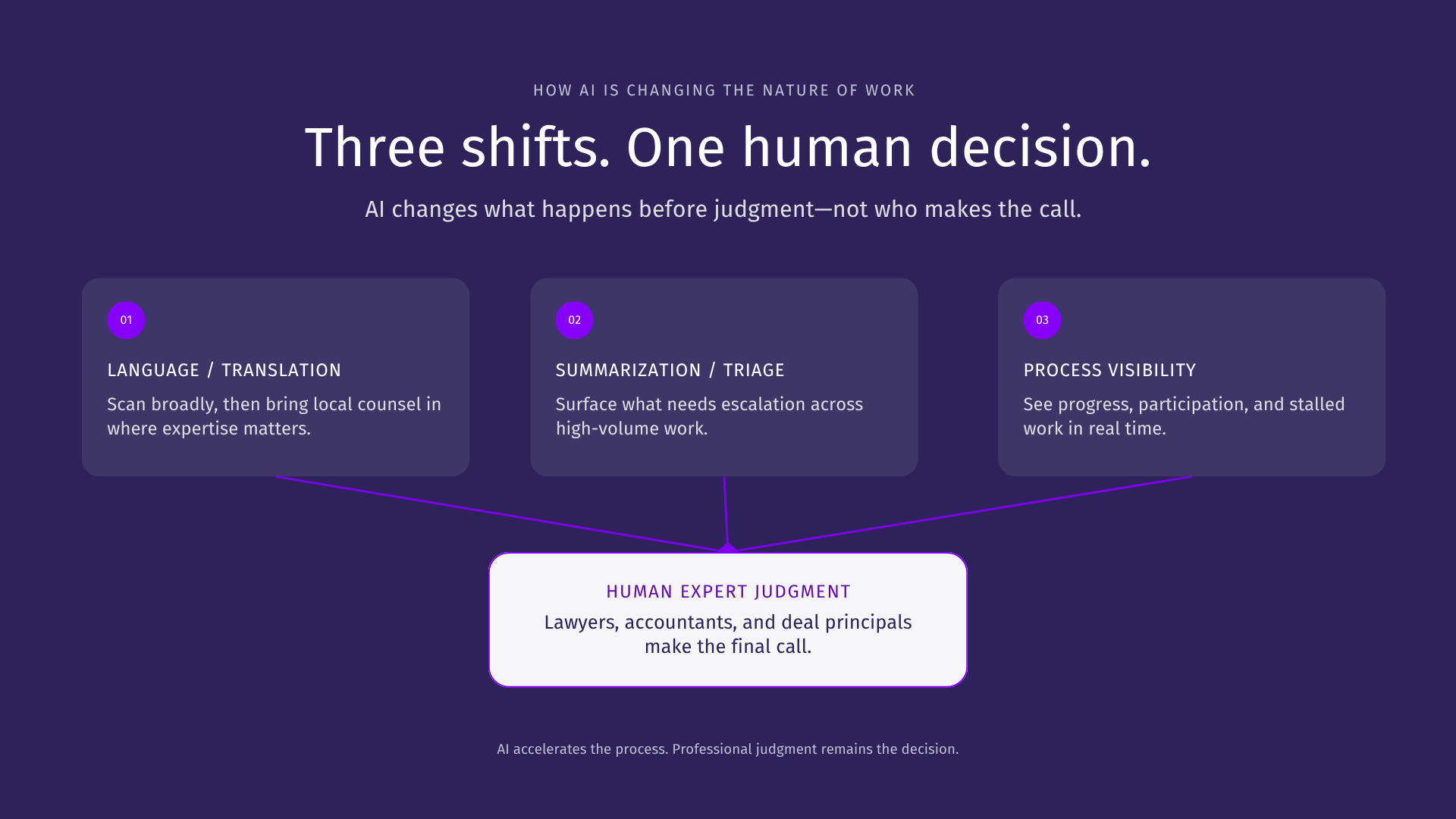
Three shifts are worth watching.
- First, language is becoming less of a gate. Machine translation has moved from a rough approximation of meaning to something reviewers can use for triage, and increasingly for first-pass review. That does not remove the need for qualified local counsel on the provisions that matter — it changes when local counsel gets involved, and on what. Instead of translating everything and reviewing what comes back, teams can scan broadly, identify what actually warrants expert attention, and direct scarce specialist hours there.
- Second, summarization is changing how teams triage volume. Being able to see the substance of a long agreement, a set of regulatory filings, or an unfamiliar corporate structure in a short, readable form lets a reviewer decide quickly whether a document is routine or requires escalation. Across a diligence file of several thousand documents, that decision is the work.
- Third, visibility into the process itself is improving. Knowing which documents have been reviewed, which parties are engaging with what, and where a workstream has stalled turns diligence status from an anecdote into something a deal lead can actually manage against.
None of these shifts replaces professional judgment. Diligence conclusions belong to lawyers, accountants, and deal principals. What AI changes is how much of the process runs before judgment is required — and how quickly the questions that need a human answer rise to the surface.
What This Means for Running a Process
For deal leaders evaluating where AI genuinely helps, a few questions are worth asking of any process, tool, or advisor:
- Does it reduce time for someone to understand a document? Speed at the front of the process compounds across a deal.
- Does it preserve control and security? Cross-border diligence involves confidential information moving among parties in different jurisdictions with different expectations. Any capability that improves speed at the expense of permission control, auditability, or governance is a poor trade.
- Does it work inside the transaction workflow, or alongside it? Capabilities that live in a separate tool creates another handoff. The value shows up when it sits where the documents and the deal team already are.
- Does it keep the expert in the loop? The right posture is AI as a first pass and a triage layer, with qualified professionals owning the conclusions.
Confidence is Still the Objective
Cross-border diligence has never been about reviewing every page equally. It is about reaching a defensible view of risk and value inside a timeline you do not fully control. AI is making that view reachable sooner and with less friction, particularly where language and volume have historically slowed everything down.
That is the standard worth holding new capabilities to: not whether it is impressive, but whether it helps a deal team move forward with greater clarity, speed, and confidence.
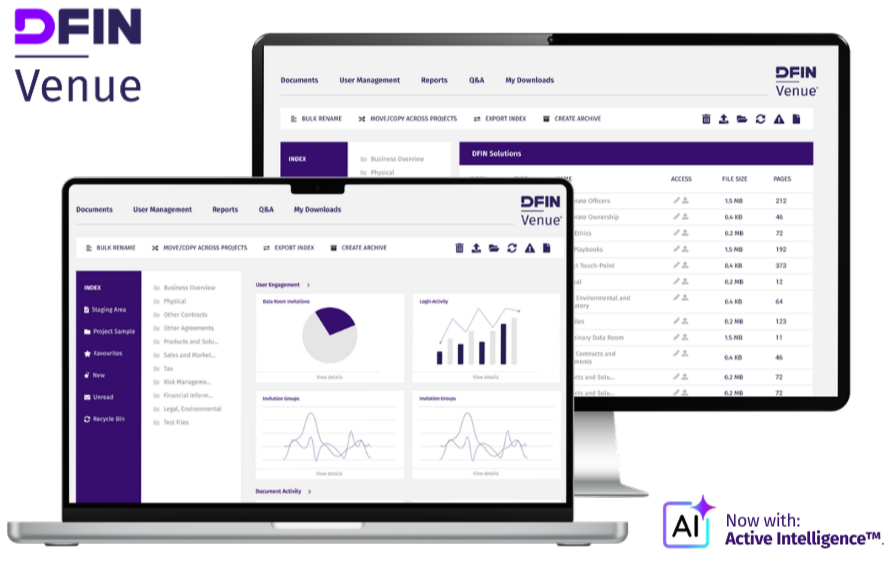
DFIN Venue is built for how deals get done — supporting secure information sharing, collaboration, and visibility across due diligence, M&A, fundraising, and IPO preparation. Venue's newest AI capabilities, AI Translations and AI Summaries, are designed to support deals in over 130 languages.