Josh Duncan on AI, Evolving Disclosure, and the Future of DFIN ActiveDisclosure

Markets change, regulations evolve, and reporting demands continue to expand; however, the need for accurate, defensible, and filing ready confidence remains constant.
Across capital markets, organizations are operating in an environment where scrutiny is intensifying and expectations are rising. Reporting teams are no longer responsible for a narrow set of financial disclosures produced once or twice a year. Instead, they are expected to support a growing ecosystem of deliverables: financial statements, statutory filings, board materials, ESG updates, and executive communications.
As reporting extends beyond traditional financial statements into these broader use cases, complexity increases. Speed alone is not the answer. What matters is discipline: clear processes, trusted data, defined responsibilities, and technology that’s purpose built for regulated environments. Without that foundation, acceleration introduces risk rather than confidence.
In this three-part video series, Josh Duncan, SVP of Product Management at DFIN, shares DFIN’s unique approach to thoughtfully incorporating AI with intention to modernize reporting workflows and continuously evolve ActiveDisclosure to meet today’s disclosure demands.
Reporting Is No Longer a Single Moment
Historically, reporting centered on a finite set of filings tied to specific deadlines. Today, reporting is an ongoing process, one that requires continuous alignment across narratives, numbers, and stakeholders.
Financial reporting remains central, but it is no longer isolated. Data and disclosures now flow into board decks, earnings materials, statutory reports, and ESG communications. Each of these outputs carries visibility as well as risk, and inconsistencies across them can undermine credibility, even if the underlying numbers are correct.
Organizations are expected to move quickly while maintaining accuracy across multiple deliverables. That tension is reshaping how reporting teams work and how technology must support them. Manual handoffs, duplicated work, and fragmented data sources make it difficult to keep pace without introducing errors.
The companies best positioned for this environment are those that invest in repeatable, controlled processes that scale beyond a single filing deadline. Rather than rebuilding workflows for each deliverable, they establish a reporting foundation that supports reuse, consistency, and clarity, allowing teams to respond to new requirements without starting from scratch.
Subscribe to receive our latest content
A Deliberate Approach to AI
AI has the potential to improve reporting but only when applied responsibly.
In regulated environments, the cost of inaccuracy is high. As a result, DFIN’s approach to AI is intentionally different from broad, experimental applications. Rather than chasing automation for its own sake, DFIN is embedding AI where it can meaningfully support judgment and reinforce existing expertise.
The goal is not to replace human expertise, but to enhance it with thoughtful tools that support better decision making, not just AI for the sake of AI. Reporting remains a discipline grounded in professional judgment, regulatory knowledge, and institutional context. AI’s role is to strengthen that judgment by reducing friction, improving visibility, and helping teams focus their attention where it matters most.
By applying AI within compliance-critical workflows, DFIN enables teams to work more efficiently while reducing risk, not adding to it.
Extending Discipline Beyond Financial Reporting
The same rigor required for 10-K and 10-Q preparation now applies across a broader reporting ecosystem.
Modern reporting teams must manage interconnected workflows: financial reporting, board decks, statutory disclosures, and ESG materials. Each group may be responsible for different outputs, but all rely on the same underlying data and narratives.
Maintaining consistency across these outputs requires more than coordination. It requires shared data, clear ownership, and structured collaboration. Without those elements, teams risk operating from different versions of the truth, creating downstream reconciliation issues and unnecessary rework.
Separating responsibilities between data preparation and reporting has become more vital than ever. When data teams can focus on finalizing numbers while reporting teams work on narratives and presentation, organizations gain flexibility. Updates can flow automatically, reducing bottlenecks and ensuring accuracy across all deliverables.
This disciplined approach allows reporting to scale beyond financial statements while preserving the control and auditability that regulated environments demand.
ActiveDisclosure: Built for Modern Disclosure Demands
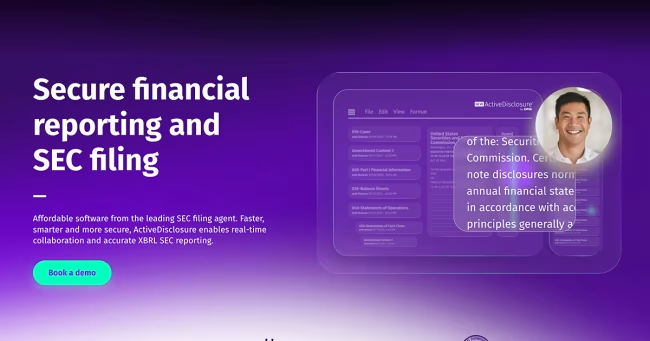
As reporting workflows become more interconnected, technology must do more than support document creation. It must act as a system of record that connects data, narratives, and outputs across teams and deliverables. ActiveDisclosure is designed to support that foundation.
With capabilities that enable shared workbooks, controlled collaboration, and consistent data across documents, the platform allows teams to work in parallel without fragmentation. Updates made in one place can flow automatically into multiple reports and presentations, reducing manual intervention and the risk of inconsistency.
New features further extend this foundation, helping organizations elevate design and branding while preserving accuracy and auditability. Reporting teams can produce materials that are not only correct but also polished and aligned with corporate identity.
As disclosure demands continue to expand, ActiveDisclosure provides the structure reporting teams need to respond with confidence.
Confidence Through Every Reporting Cycle
Regulatory obligations do not pause, and neither does the need for trusted reporting processes.
Across market cycles, reporting teams are expected to deliver clarity in the moments that matter most. That requires more than speed or point-in-time solutions. It requires platforms and processes designed to support ongoing readiness, evolving requirements, and increased scrutiny.
By combining deep domain expertise with modern, purpose-built technology, DFIN ActiveDisclosure continues to help organizations navigate complexity with confidence, across reporting cycles, market conditions, and evolving disclosure expectations.

.jpeg)