When companies want to create securities as part of a spin-off or carve-out, they must file certain forms to create and list the securities. SEC Form 10-12B is a common requirement. This form registers a class of securities under Section 12(b) of the Securities Exchange Act of 1934. Unlike many Securities Act registrations, such as an S‑1 commonly used in connection with an initial public offering, SEC Form 10-12B is an Exchange Act registration. These types of registrations do not create new shares, merely registering them so that they can be traded on a national securities exchange like the NYSE or Nasdaq.
Form 10-12B can be used in a variety of applications, such as through a spin-off, carve-out, or other Exchange Act registration. It is most commonly used in spin-offs. With correct information in the filing, the registration becomes effective after 60 days, unless the SEC decides to accelerate or delay it.
When is Form 10-12B Required?
Companies that want to create a new class of shares have to go through a number of steps to achieve it. Form 10-12B does not actually create new shares, but it registers a new class of shares with the SEC for exchange trading. It is commonly filed along with other listing applications. The form exists to provide critical information to current and potential investors about the class of shares created for the spin-off, which involves the creation of an independent company from a subsidiary. Shares are distributed among shareholders of the parent company and do not raise cash.
Although Form 10-12B and Form 10-12G seem similar, they are quite distinct. Form 10-12G involves registration requirements for private companies with a certain amount of investors and assets, a common part of private company financial reporting and disclosure management. Form 10-12B creates exchange-listed securities and is an important component for many companies going public. Form 10-12B requires adherence to the listing standards of the exchange, as well as SEC filing requirements.
Key Components of SEC Form 10-12B
SEC Form 10-12B requires several disclosures that may call for significant document details. These include:
- Business Overview: Description of operations, positioning in the industry, and competitive landscape
- Risk Factors: Risks related to the business and spin-off, including market, operational, regulatory, and transactional-related risks
- Management Discussion & Analysis (MD&A): Management review of historical finances, liquidity, capital resources, and other forward-looking considerations
- Financial Statements: Two or three years of audited financial statements, depending on issuer status, plus pro forma financial information for the spin-off
- Security Ownership: Disclosure of beneficial ownership, including shareholders who own more than 5% of the registered class, as well as Section 16 reporting obligations for insiders. Companies may also need to consider related transparency obligations under the Corporate Transparency Act
- Executive Compensation: Compensation structure for executives
- Corporate Governance: Composition of the board, as well as committee structure and other internal controls
- Exhibits: Various document details, like material contracts, charter documents, or separation agreements for carve-outs
A high degree of detail, as well as consistency and accuracy, are key for prompt SEC review and approval.
The Filing Timeline and SEC Review Process
When a company files SEC Form 10-12B, they need to expect up to 60 days of SEC review, possibly longer in certain cases. Businesses file the registration statement through EDGAR, the SEC’s online filing system. The filing becomes effective automatically after 60 days unless the company withdraws it or the SEC accelerates approval.
In some instances, the SEC will issue comment letters requesting revisions or corrections. If the company must file an amendment for Form 10-12B, they usually file it under the heading Form 10-12B/A. If the SEC does not issue any letters, the company must still meet rules for investor communications and confirm approval for the listing from the target exchange.
Common Use Case: Corporate Spin-Offs
SEC Form 10-12B is a common filing for spin-offs because it allows shareholders to trade shares on a public exchange without requiring the company to issue new shares for the public to buy, as they would with an IPO. During a spin-off, the parent company issues shares for the spin-off to current shareholders.
Shareholders who do not want to keep their shares from the spin-off cannot trade them unless the shares are made available on the public exchange, through the filing of Form 10-12B. Early and comprehensive investor communication is a critical element, as the new shares may create tax concerns that investors need to consider.
The creation of a spin-off requires pro forma financials. These disclosures provide financial forecasting and show that the spin-off is now a standalone entity, with transition services agreements and separation and distribution agreements.
Compliance and Disclosure Risks
Incomplete filings create risk for investors, which is why the SEC oversees the details provided. Companies may face required revisions or other negative consequences if they:
- Fail to disclose all risk factors
- Provide a weak narrative in MD&A
- Show inconsistent financial data
- Forget to include necessary exhibits
- Do not coordinate between legal, finance, and investor relations teams
- Inconsistently follow I
inline XBRL tagging requirements - Fail to coordinate compliance with the exchange listing
Sufficient preparation for this filing requires robust internal controls, consistent data entry and documentation, and expert review before filing.
Technology’s Role in Managing Form 10-12B Filings
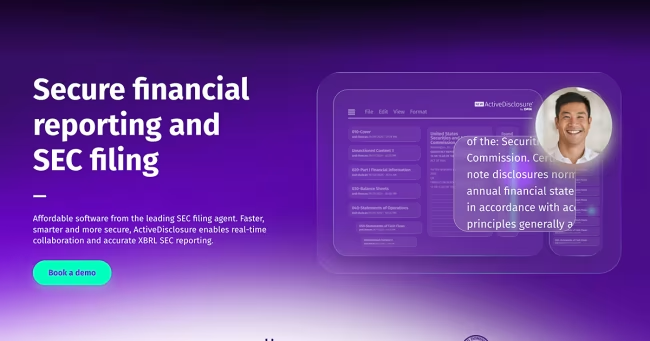
Since SEC Form 10-12B is just one of many filings that a company may need to make as part of a spin-off or other major transaction, the use of technology is key. DFIN’s SEC filing software help businesses streamline complex filings, promote collaboration among teams, and reduce overall risk with these features:
- Centralized workflows for drafting and review
- Version control, important for amendments
- Financial data integrated from company data management
- Inline XBRL tagging and support for required filing formats
- Creation of audit trails and permissions
- Collaboration across functions, such as legal, finance, and executive teams
These advantages can help minimize last-minute errors that invite SEC scrutiny and hurt investor confidence, thus ensuring a stronger result at the time of filing.
Simplify Exchange Act Registration
A public transition, such as a spin-off, creates a number of risks for a company. Companies and compliance teams look to reduce or manage these risks, decrease surface area for friction, and pave the way toward success. Form 10-12B requires extensive SEC filing details, which can be intimidating without the right tools.
Expert solution providers like DFIN offer secure collaborative environments, guided workflows to ensure SEC compliance, and real-time updates that include SEC comments. The ideal tool provides integrated EDGAR submission, along with support for spin-offs, carve-outs, and direct listings. With the right assistance, your company can move confidently into public markets.