Foreign financial institutions that serve as institutional trustees under indentures subject to the Trust Indenture Act of 1939. One of those requirements is SEC Form T-6, a filing used by certain foreign institutions to demonstrate their qualifications to serve as an institutional trustee under the Trust Indenture Act.
Although Form T-6 is less common than many SEC filings, it plays an important role in protecting investors and supporting cross-border capital markets. Preparing the filing requires careful documentation, supporting evidence, and compliance with SEC filing requirements.
For decades, DFIN has helped organizations navigate complex SEC reporting, EDGAR submissions, and disclosure management. Understanding the purpose of Form T-6 and the filing process can help foreign trustees prepare more efficiently while reducing the risk of regulatory delays.
What Is SEC Form T-6 and Why It Matters
SEC Form T-6 is a statement of eligibility filed by certain foreign banking institutions seeking authorization to serve as the sole institutional trustee for indenture securities issued under the Trust Indenture Act of 1939.
Unlike many SEC forms that accompany an issuer's registration statement, Form T-6 is a standalone filing submitted by the prospective trustee. The filing provides information regarding the institution's eligibility under the Trust Indenture Act and forms part of the SEC's review of the related offering and indenture documentation.
The filing supports one of the Trust Indenture Act's primary objectives: protecting bondholders by ensuring trustees possess the financial strength, independence, and regulatory oversight necessary to safeguard investor interests throughout the life of the indenture.
Who Files and Who Qualifies?
Form T-6 is filed by foreign persons organized under the laws of jurisdictions outside the United States that seek to establish their eligibility to serve as institutional trustees.
Typical applicants include:
- Foreign commercial banks
- International trust companies
- Foreign banking institutions authorized to exercise corporate trust powers
The trustee acts independently on behalf of bondholders and should not be confused with the issuer or obligor issuing the securities. Instead, the trustee administers the indenture, monitors compliance with its terms, and helps protect investors throughout the offering.
By comparison, a domestic national bank or U.S. trust company generally demonstrates eligibility by filing Form T-1 rather than Form T-6.
Preparing the Statement of Eligibility
Preparing Form T-6 involves more than completing the application itself. Supporting documentation should clearly demonstrate that the applicant satisfies the eligibility requirements established under the Trust Indenture Act.
Applicants may be required to provide supporting documentation such as:
- Evidence of adequate capital and surplus
- Audited financial statements
- Documentation demonstrating authorization to exercise corporate trust powers
- Information showing comparable supervision by home-country banking regulators
- Corporate charter or similar organizational documents
- Board resolutions authorizing the filing
- Designation of a U.S. agent for service of process through Form F-X, when required
Applicants should disclose relationships or circumstances relevant to trustee independence and the applicable conflict-of-interest provisions of the Trust Indenture Act.
Complete and well-organized supporting documentation can help streamline the review process and reduce requests for supplemental information.
SEC Form T-6 vs. Form T-1
Although both filings establish trustee eligibility, they apply to different organizations.
| Form T-6 | Form T-1 |
| Filed by foreign banking institutions | Filed by U.S. banks and trust companies |
| Standalone statement of eligibility | Filed as an exhibit to an issuer registration statement |
| Demonstrates eligibility under foreign supervision | Demonstrates eligibility under U.S. regulatory requirements |
Understanding which filing applies depends primarily on where the trustee is organized, not where the securities are offered.
Filing Through EDGAR and Supporting Documentation
Form T-6 is submitted electronically through the SEC's EDGAR system. Applicants should ensure all required exhibits are properly formatted and organized before submission.
Common supporting exhibits include audited financial statements, regulatory or supervisory letters, organizational documents, board resolutions, and certified English translations when applicable.
If material information changes after submission or the SEC requests additional information, applicants may need to file Form T-6/A to amend the original application. Maintaining clear accession-level tracking and organized supporting files can simplify the amendment process.
During its review, SEC staff may evaluate capital adequacy, supervisory equivalence, trustee independence, and supporting documentation during the review process.
How DFIN Helps Simplify SEC Filings
Preparing specialized SEC filings often requires coordination among legal counsel, finance teams, and outside advisors. DFIN helps organizations streamline that process with integrated technology and experienced filing support.
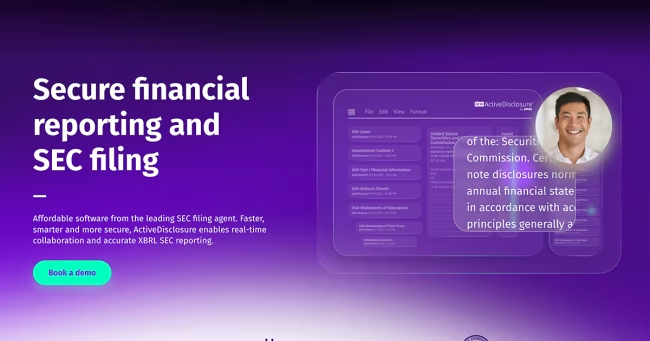
ActiveDisclosure simplifies SEC document preparation, collaborative drafting, XBRL tagging, and EDGAR-ready formatting. Venue provides a secure virtual data room for collecting and organizing supporting exhibits during transactions and regulatory filings. Organizations with broader regulatory reporting needs can also leverage Arc Suite to support compliance workflows and document management.
Together, DFIN's solutions help organizations improve accuracy, strengthen governance, and streamline complex filing processes.
Practical Checklist Before Filing
Before submitting Form T-6, confirm that you have:
- Gathered all corporate and financial documentation.
- Compiled evidence of supervisory equivalence.
- Prepared required conflict-of-interest disclosures.
- Validated EDGAR formatting and exhibit sequencing.
- Completed legal and management review.
- Confirmed all required signatures and approvals.
Careful preparation helps reduce filing delays and supports a more efficient SEC review process.
Looking for additional guidance on SEC reporting and disclosure management? Explore DFIN's solutions to simplify EDGAR filings, improve collaboration, and support regulatory compliance throughout the filing lifecycle.
Frequently Asked Questions
What is Section 6 of the Securities Act?
Section 6 establishes the registration requirements for securities offerings under the Securities Act of 1933. While it governs issuer registration, Form T-6 relates specifically to trustee eligibility under the Trust Indenture Act.
What is SEC Form T-3?
Form T-3 is used to qualify an indenture under the Trust Indenture Act when no Securities Act registration statement is being filed.
What is an SEC form?
An SEC form is a standardized filing used to provide disclosures required under federal securities laws for registrations, periodic reporting, transactions, or other regulatory purposes.
What is SEC Form T-1?
Form T-1 is the statement of eligibility filed by qualified U.S. institutional trustees and is typically included as an exhibit to an issuer's registration statement.