
Presenting financials to the board often means distilling complex information down into concise, easily digestible pieces. Considering that board members may not have the same levels of financial literacy as you do, financial presentations must factor in the audience's ability to comprehend financial information. This financial statement presentation guide explains the best way to go about presenting quarterly financial reports and other statements to the board with tips to help you convey what matters most in clear language.
Before we dive into the guide, let's look at the purpose of an investor relations presentation like this.
While information is a top objective of any financial health report, the real goal in most cases is decision-making. By keeping this high-level overview in mind as you work with financials, you'll be able to pull together a report that aids decision-making, rather than hinders it by confusing the audience with unnecessary details. What follows is a brief overview of how to prepare, structure, and deliver annual reports as effectively as possible.
Financial Report Presentation Checklist
When preparing to present a financial report, it’s important for executives to keep these points in mind:
Understand your audience and ensure the narrative is relevant to them
Identify key insights and metrics to provide a strong, defensible foundation for the findings
Structure the report clearly to prevent confusion
Use visuals to simplify data and make the report easily scannable
Build a narrative around performance that provides necessary context
Focus on business impact
Prepare for questions in advance so you won’t be caught off-guard
Provide clear next steps
Presentation of Financial Statements: How to Prepare
Proper preparation is essential for a financial presentation to a board of directors. Preparing smartly saves time down the road, because it helps you to understand what is and is not necessary to include.
Think through these two areas ahead of time:
Audience financial literacy levels: Financial literacy means the ability of your audience to comprehend financial information. A board member with an MBA may be well-versed in acronyms and capable of reading complex graphs, while one that does not come from a business background may feel lost in the numbers. When you understand the makeup of the board, you can strike the right balance.
Relevant data: Your report should help the board consider questions and chart the best path forward. So ... what data is truly relevant or necessary to the questions at hand? Less often can be more when it comes to financial data, as sharing too much can leave an audience feeling overwhelmed and lead to an excessive number of questions at the end.
Data sourcing: Having authoritative sources for data is critical. When it comes from a single source of truth, executives can be sure that the information contained in their reports will be of the highest quality and with the strongest data integrity possible.
Reflecting on these areas helps you understand what your audience needs to review and how to best present the information. If the audience has a lower level of financial literacy, you may choose to include more charts and graphs. If your audience is highly literate about finances, pairing raw data like figures with a contextualized narrative summary can help them quickly and confidently analyze everything from SEC forms to proxy statements to cash flow to balance sheets.
Once you have a strong understanding of the data that is needed, gather it from financial reporting software.
Key Components of the Financial Report
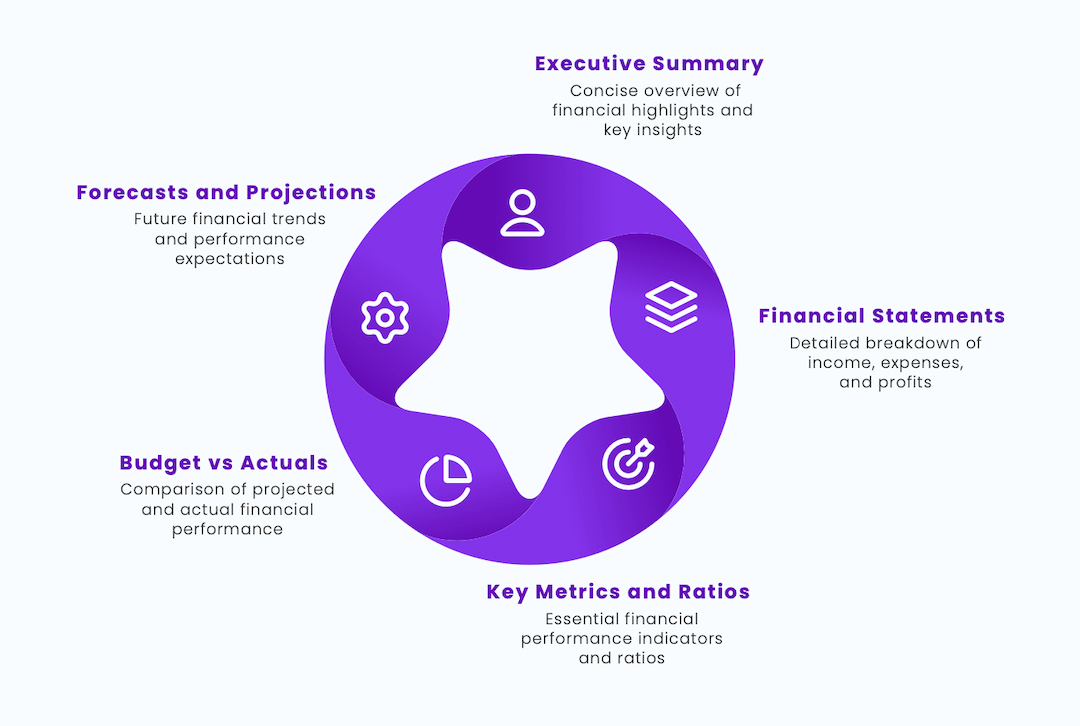
Most financial reports consist of these key sections:
- Executive Summary: This is a high-level overview of the information contained in the report, often written after you complete the report.
- Financial Statements: There are several kinds of financial statements that might be included in a report, such as a cash flow statement or balance sheet.
- Key Metrics and Ratios: These add context to the raw financial data, highlighting what is most important to consider.
- Budget vs. Actuals: By comparing the actual performance against the budgeted figures, the report tells a story about how the business performed versus expectations or projections.
- Forecasts and Projections: Drawing on data, this section combined narratives and graphs to make educated guesses around the future of the company.
How to Structure Your Financial Presentation
A strong presentation tells a story focused around the most important points and leaving out irrelevant or extraneous data. Simply dumping as much data as possible on the audience leaves them struggling to find relevance and insights. This is where the preparation ahead of time comes in hand.
Understanding your audience, the focus of the presentation, and their background and level of financial literacy will help you assess the right way to format information.
Visual aids such as tables, trend lines, and variance charts highlight key points. They allow board members to focus on the main takeaways and top-line trends.
The numbers tell a story. Using a narrative flow highlights the underlying story. Your narrative might be sequential (this happened, then this happened) or thematic (these data points have this underlying factor in common).
Use summary sections to connect the financial story to the bigger picture: What happened and why does it matter?
It's common to present the financial information using a slide show. The golden rule with slides is "less is more." Cluttered slides confuse audiences who lose focus.
Presentation Tips
Write out your thoughts. Then, go through your notes and remove any jargon. A successful presentation of financial results is clear, concise, and engaging.
Try to limit slides to one idea each. This not only keeps the presentation organized, but it also ensures the audience will be able to digest each insight before moving on to the next point. Clarity and consistency throughout the presentation is key to success.
Pick several points in the presentation where you will pause and take questions. Allowing questions and debate not only keeps the audience engaged, but also it helps you to figure out what your audience does and does not understand. If a key point isn't landing as you hoped, you then have time to rephrase.
Finally, practice the presentation multiple times until you can talk without speaking from your notes. This will help you stay on track if someone asks you questions.
Addressing Challenges
When presenting financials to a board, you must respect the time allotted. When practicing, time your presentation, so it falls within the allotted time and leaves room for questions.
Keep an eye on the time when giving the presentation.
While most questions will be straightforward, there are challenging questions. If you receive a difficult question, stay calm. Take a deep breath. Then, use the data to provide answers. Your goal is to speak logically, rather than emotionally, and connect the question back to the data.
If the audience is confused during the question-and answer period, do your best to identify which areas of the presentation were unclear. For the best results, you may need to adjust how you explain the material in real-time as you’re giving the presentation if you notice audience members looking confused.
How to Deliver an Effective Financial Presentation
The success of your presentation will depend a great deal on how well you deliver it. Here are some basic public speaking tips to keep in mind as you prepare for your presentation:
- Speak clearly and with confidence
- Maintain eye contact with audience members and remember to pay equal attention to all
- Avoid reading directly from the slides as much as possible
- Guide the audience through the key insights, emphasizing them when they appear in the slides
- Reinforce main takeaways at the end
Post-Presentation Best Practices
Your work does not end after a presentation.
Close the presentation by summarizing the key takeaways from the report.
Talk about next steps: What action items remain? Who is in charge of completing them? If board members have questions, how should they contact you?
Finally, provide copies of the report to board members, so they can go deeper at their own pace. Make sure to include copies of any supporting documents, such as financial statement tie-out binders.
Afterward, ask for feedback from the board. This keeps lines of communication open and helps you to improve your performance.
Strive for an attitude of continuous improvement. If something did not go as well as you hoped, reflect upon it. What could lead to a different outcome next time? This attitude will help you adapt the model to better serve the needs of your audience and, ultimately, the company's goals.
Financial presentations are an essential part of running a business. By understanding the key purpose of these presentations and how to present a financial report to best connect the data to the audience, you can prepare for success. The next time you have to present, it will be easier because you know what to expect. Technology solutions such as the financial reporting software and virtual data rooms provided by DFIN can lead to efficiency and accuracy gains by providing you with single sources of truth for data and financials.