The traditional U.S. trading day is changing. As exchanges move toward nearly continuous weekday trading, investors will have more opportunities to trade U.S. equities outside the trading hours that have historically defined the market.
For public companies, the shift raises questions that extend beyond market mechanics. How will 23×5 trading work? What does it mean for the timing of corporate disclosures? And should companies begin reexamining processes built around established market hours?
While regulators continue to consider some of these questions, companies can start by understanding what is changing and evaluating where longer trading hours could intersect with their existing disclosure practices.
What is 23×5 Trading?
23×5 trading refers to Nasdaq’s and NYSE Arca’s plans to launch extended trading hours on December 6, 2026. https://www.nasdaq.com/23-5-trading.
Under the new schedule, a new overnight trading session will run from 9 p.m. to 4 a.m. ET, complementing existing pre-market, regular and post-market trading. The exchanges will pause activity between 8 p.m. and 9 p.m. ET each trading day, effectively trading 23 hours a day, five days a week.
Importantly, the traditional core trading session isn't disappearing. Nasdaq has said its Opening and Closing Crosses and core trading session will remain, even as the overall window in which investors can trade expands. NYSE Arca’s Core Session will also continue to open at 9:30 a.m. ET, with its Official Closing Price published following the Core Closing Auction at 4 p.m. ET. Nasdaq has also stated that issuer disclosure obligations and reporting requirements remain unchanged under 23×5 trading.
Why are Trading Hours Expanding?
U.S. markets increasingly serve a global investor base. The move toward 23×5 trading has largely been in response to global demand for access to U.S. equities, as investors seek to participate in the market according to their own time zones and information cycles.
Supporting that access requires more than extending exchange hours. Market infrastructure has also been adapting, including expanded clearing operations, securities information processor hours, and overnight volatility protections and processes for corporate actions. Nasdaq and NYSE Arca expect to use mandatory overnight halts for certain complex corporate actions when additional processing time is needed.

What Could 23×5 Trading Mean for Public Companies?
One of the biggest questions is how nearly continuous trading could affect corporate disclosure practices.
Companies have traditionally considered established market hours when determining when to release earnings and other material information. Overnight trading could make those boundaries less distinct.
The SEC itself has raised this issue. At its September roundtable on extended-hours trading, Commissioner Hester Peirce asked whether issuers may need to change when they file and release material information in a 23×5 environment. She also raised questions about whether EDGAR may need to change to support timely dissemination of information when markets are trading overnight. That could put additional attention on the timing of after-hours filings, including Form 8-K disclosures.
What Should Companies Be Considering Now?
For finance, legal, and investor relations teams, the transition provides an opportunity to review processes that may have been designed around traditional market hours.
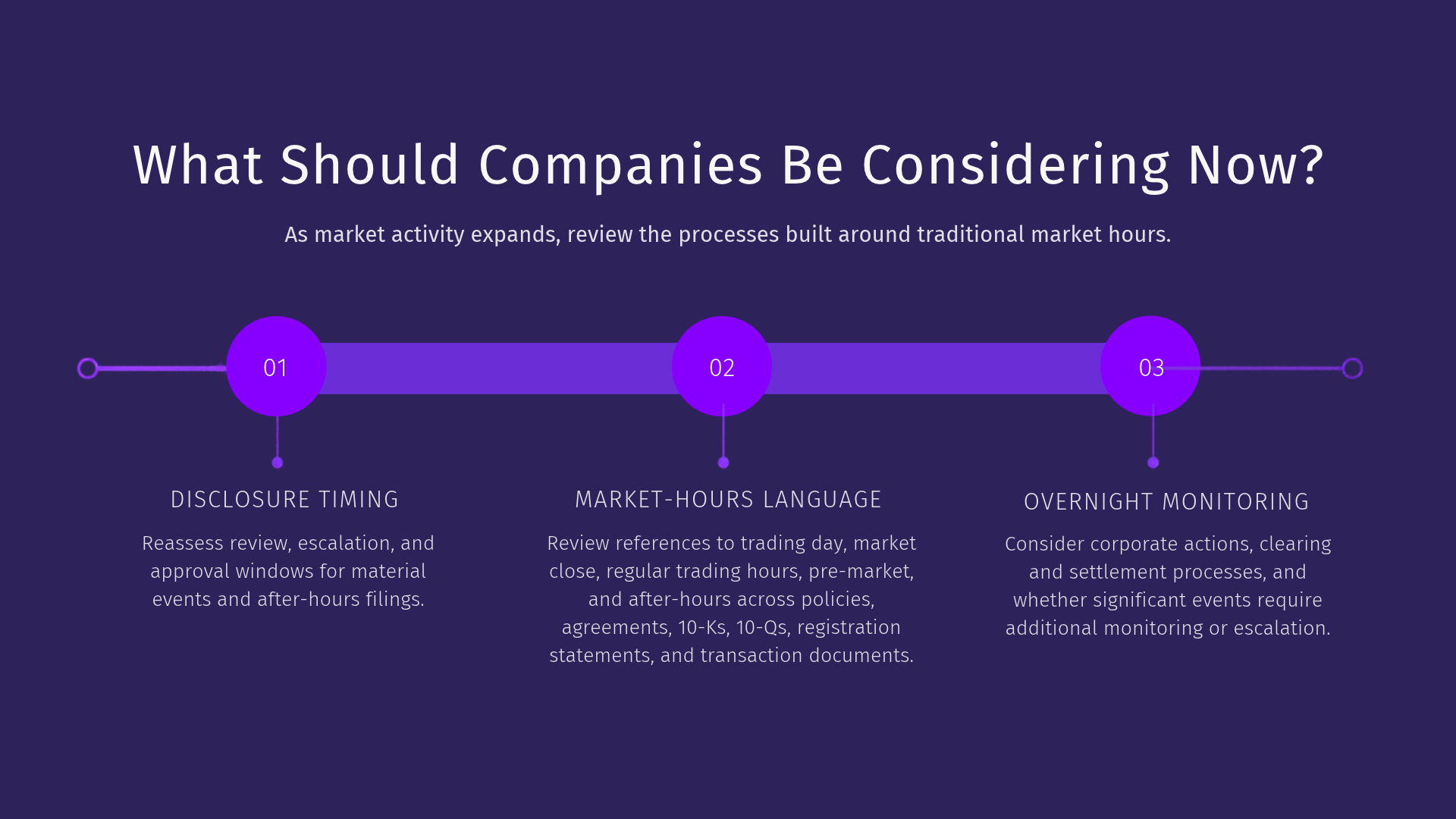
- Review disclosure timing and filing processes. Companies may want to evaluate whether existing approaches to disclosure review, escalation and approval remain appropriate as the window for market activity expands, particularly around material events and after-hours filings.
- Review market-hours terminology in disclosure and transaction documents. Companies may want to identify references to concepts such as “trading day,” “market close,” “regular trading hours,” “pre-market” or “after-hours” in corporate policies, agreements and disclosure materials. Forms 10-K and 10-Q, Securities Act registration statements and related transaction documents may be logical places to review when they contain this type of terminology.
- Consider corporate actions and overnight monitoring. The daily one-hour pause supports certain corporate-action processing as well as clearing, settlement and reference-data processes. Companies may also want to discuss with counsel whether significant anticipated events warrant additional monitoring or escalation procedures. The SEC roundtable raised the question of whether issuers should monitor overnight trading in their shares for extreme market moves.
The goal at this stage is not to predict regulatory outcomes, but to understand where existing practices intersect with a changing market structure and determine where closer attention may be appropriate.
Preparing Disclosure Processes for an Evolving Market
The expected move by Nasdaq and NYSE Arca toward 23×5 trading represents another step toward a more continuous U.S. market. While its full implications for issuers will develop over time, companies can use this transition as an opportunity to examine the processes behind financial reporting and disclosure, as well as the policies and documents that rely on traditional market-hour definitions.
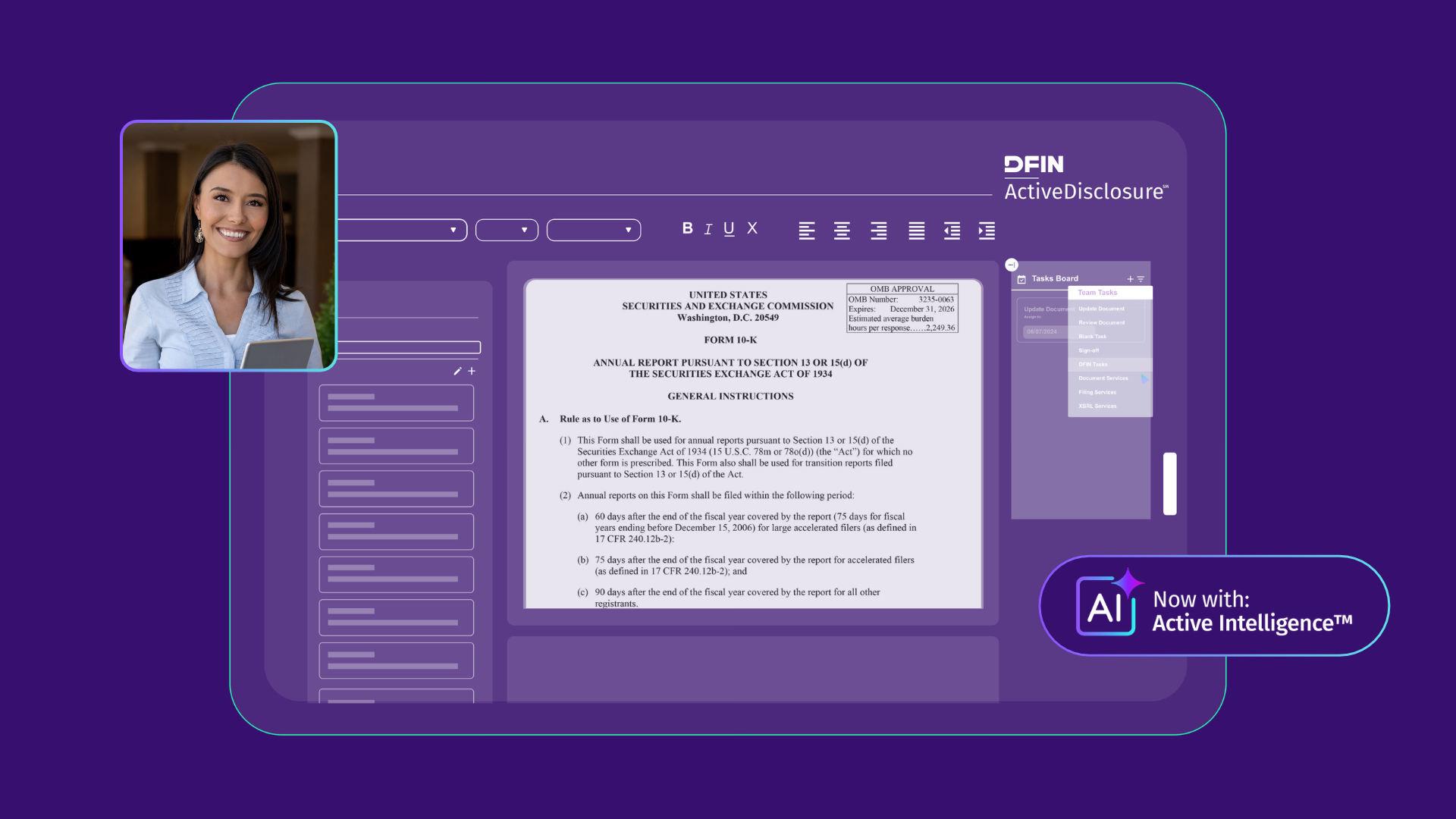
DFIN ActiveDisclosureSM supports SEC filing workflows including Forms 10-K, 10-Q, and other SEC filings, as well as registration statements such as Forms S-1, S-3, and S-4. Teams can collaborate in real time, manage document changes and approvals, maintain version history and audit trails, and support XBRL requirements within a connected reporting environment. DFIN reporting and filing specialists are also available when additional expertise is needed.
As market hours evolve, a connected, controlled reporting process can help teams manage established filing obligations with greater visibility and confidence.