Mergers and acquisitions require precision, transparency, and disciplined disclosure. At the center of many successful M&A transactions is a secure, well-structured M&A data room.
An M&A data room is a centralized digital repository used to store, organize, and share confidential documents during a transaction. In complex transactions, the data room is far more than a storage location. It is the backbone of the diligence process, enabling secure collaboration between stakeholders while protecting sensitive information. Historically, and in limited cases today, transactions relied on physical data rooms where printed files were reviewed on-site under supervision. That model created logistical friction, limited access, and increased risk. Today, modern transactions rely on a secure virtual data room, often referred to as a VDR, to streamline disclosure while maintaining strict controls over access to sensitive data.
The data room supports transparency and fairness in dealmaking. It helps sellers provide consistent access to material information, reducing information asymmetry and supporting defensible valuation discussions. Whether supporting a competitive auction or a negotiated acquisition, the platform plays a critical role in the success of the M&A deal.
Across transactions, we regularly see the following stakeholders rely on data rooms:
- Investment bankers managing the sale process
- Corporate development teams evaluating targets
- Legal counsel reviewing contractual risk
- Auditors verifying financial accuracy
- Regulators assessing compliance (where applicable)
- Potential bidders conducting diligence
When managed correctly, the data room strengthens transaction credibility and supports orderly execution.
What Goes Inside an M&A Data Room?
The strength of a data room lies in both the quality of its content and the structure used to organize it. Buyers expect thorough, consistent disclosure across every functional area of the business.
In our work with deal teams, we see successful data rooms organized into clear, logical categories that mirror how buyers analyze risk. The structure should anticipate the questions buyers will ask and make it easy for them to trace supporting documentation. A disorganized data room slows review, increases repetitive Q&A, and may signal operational weakness.
Corporate Information
- Articles of incorporation
- Organizational charts
- Subsidiary records
- Board minutes (or relevant summaries)
This section establishes legal structure, ownership, and governance. Buyers assess control rights, subsidiary relationships, and historical board decisions to identify structural complexity or approval constraints.
Financial Documents
- Audited financial statements
- Management accounts
- Forecasts and projections
- Debt schedules
Financial materials are often the most heavily scrutinized section of the data room. Buyers use them to test earnings quality, assess working capital trends, evaluate debt obligations, and validate assumptions embedded in valuation models. These documents are a key input into established M&A valuation methods during buyer modeling and negotiation. Clear reconciliation between audited results and internal management reporting builds credibility and reduces pricing disputes.
Legal & Compliance
- Material contracts
- Litigation history
- Regulatory filings
- Permits and licenses
Legal disclosures help buyers evaluate contingent liabilities, contract termination rights, change-of-control clauses, and regulatory exposure. Incomplete contract disclosure can delay negotiations or materially affect deal pricing.
HR & Compensation
- Employee agreements
- Equity plans
- Benefits documentation
Human capital matters in nearly every transaction. Buyers assess retention risk, incentive alignment, and potential obligations triggered by a change of control.
Tax & Accounting
- Tax returns
- Audit correspondence
- Accounting policies
Tax exposure and accounting methodology can materially impact transaction structure and post-close integration planning.
Commercial & Operations
- Customer contracts
- Supplier agreements
- Intellectual property portfolio
- Technology systems
Operational documentation enables buyers to evaluate revenue durability, supply chain resilience, and technology scalability.
Each document uploaded into the data room should be current, complete, and version-controlled. Incomplete or inconsistent disclosure slows the diligence process and can introduce execution risk.
A well-prepared M&A data room reflects organizational discipline and strengthens buyer confidence. It signals readiness, reduces friction, and reinforces trust throughout the transaction lifecycle.
The Role of Data Rooms in Due Diligence
The data room becomes most critical during M&A due diligence. Buyers use the platform to assess risk, confirm representations, and refine valuation assumptions.
Through structured M&A due diligence, buyers identify potential liabilities, operational weaknesses, or compliance gaps.These findings can influence pricing adjustments, indemnities, and closing conditions. For example, undisclosed contractual termination rights or pending litigation may shift negotiating leverage. Detailed financial disclosures may uncover working capital adjustments that impact final purchase price.
The data room supports multiple layers of review. Financial advisors evaluate earnings quality and cash flow durability. Legal counsel reviews contractual risk. Tax advisors assess structural implications. Operational specialists analyze scalability and integration complexity.
For sellers, the data room provides protection. By centralizing disclosure, management can demonstrate that confidential information was shared consistently with all bidders. This supports defensibility around representations and warranties and reduces post-closing dispute risk.
Auditors and counsel rely heavily on the platform as well. Activity logs and a detailed audit trail document who accessed documents, when access occurred, and related activity. This documentation becomes particularly valuable in highly regulated industries or cross-border transactions where regulatory oversight may follow.
The data room reduces information asymmetry. It enables structured Q&A workflows and supports advisors involved in fairness opinion analysis by ensuring advisors work from a consistent set of materials.
When managed properly, it enhances deal certainty, strengthens negotiation posture, and compresses transaction timelines.
Security and Compliance Considerations
Security is not optional in M&A. Transactions involve material nonpublic information, sensitive documents, and highly confidential documents that, if leaked, can disrupt negotiations or, in some circumstances, affect market dynamics.
A secure virtual data room must protect against unauthorized access, data breaches, and internal misuse. Exposure of strategic plans, financial projections, or customer contracts can alter competitive dynamics and create regulatory consequences.
Key security capabilities include:
- Granular access controls by role or bidder tier
- Encryption at rest and in transit
- Dynamic watermarking
- Download and print restrictions
- Real-time activity monitoring
These controls are not simply technical features. They are governance safeguards. Limiting access to sensitive data by bidder stage reduces unnecessary exposure. Watermarking discourages improper distribution. Activity monitoring provides transparency and deterrence.
Without these safeguards, exposure of sensitive information can create insider trading risk, reputational harm, or regulatory scrutiny if material nonpublic information is misused.
Data residency considerations are also critical in cross-border deals. Certain jurisdictions impose data residency, localization, or cross‑border transfer requirements. A sophisticated VDR provider must support these requirements while maintaining global accessibility for authorized participants.
Strong security architecture also supports compliance obligations. Maintaining secure records of disclosure activity strengthens defensibility in regulatory inquiries or shareholder litigation.
In our experience, disciplined data governance builds trust among bidders and reinforces transaction integrity from launch through closing.
Best Practices for Managing an M&A Data Room
Preparation is one of the most overlooked drivers of deal success. Companies that prepare their data room before launching a sale process consistently reduce delays and improve buyer engagement.
Early preparation allows internal teams to identify disclosure gaps, reconcile inconsistencies, and organize materials without the pressure of live negotiations. It also enables management to anticipate likely buyer questions and proactively address them.
We recommend the following best practices:
- Establish a standardized folder taxonomy: Create a clear, intuitive folder structure that mirrors how buyers conduct analysis. Organize materials by functional area and transaction relevance, not internal departmental silos. Consistent naming conventions, indexing standards, and logical categorization reduce confusion and prevent repetitive information requests. A well-structured taxonomy allows bidders to move efficiently through the diligence process and signals operational maturity.
- Assign internal document owners: Designate accountable individuals within finance, legal, HR, tax, and operations to manage their respective sections. Document owners should be responsible for accuracy, completeness, and timely updates. Clear ownership prevents last-minute scrambles, ensures responsiveness to Q&A requests, and reduces the risk of inconsistent disclosure. It also improves cross-functional coordination throughout the process.
- Validate contracts and key financials in advance: Conduct internal reviews of material agreements, debt schedules, and financial reporting before uploading. Confirm that executed versions are included, amendments are consolidated, and reconciliations between management accounts and audited results are clear. Address discrepancies early to avoid valuation disputes later. Buyers quickly detect inconsistencies, and unresolved issues can erode confidence.
- Implement structured redaction protocols: Develop guidelines for redacting competitively sensitive data, personal information, or proprietary pricing details. Ensure redactions are applied consistently and clearly labeled. Over-redaction can frustrate bidders, while under-redaction may expose unnecessary risk. A balanced approach preserves confidentiality while maintaining transparency.
- Maintain version control discipline: Use controlled upload processes to ensure only the most current and approved versions of documents are available. Archive outdated materials appropriately and clearly identify updated files. Version confusion can delay diligence, create negotiation friction, and weaken credibility. A single source of truth strengthens trust and supports defensible disclosure.
Ownership matters. When each functional area is responsible for maintaining its section, updates remain consistent and accountability is clear.
Staged disclosure is another critical tool. Sensitive documents may be restricted to later phases of the diligence process based on bidder seriousness. This approach balances transparency with prudent risk management.
A single source of truth prevents conflicting versions of a specific document from circulating among advisors. Version confusion can create negotiation setbacks or credibility concerns.
Pre-Deal Data Room Readiness Checklist
- Organize financial statements
- Validate key customer and supplier contracts
- Clean capitalization tables
- Identify highly sensitive documents
- Align legal disclosures
- Confirm regulatory compliance
When these steps are completed early, the diligence process becomes more efficient and predictable. Buyers gain confidence in management’s preparedness, and transaction momentum is preserved.
How Technology Accelerates M&A Execution
Modern transaction platforms go far beyond basic file storage. The right virtual data room platform provides intelligence that improves decision-making across the entire deal lifecycle. Analytics tools allow sellers to monitor bidder behavior through activity heatmaps. If a bidder repeatedly reviews certain commercial contracts or financial projections, that insight may signal valuation focus or strategic intent. Sellers can tailor follow-up discussions accordingly.
Structured Q&A workflows accelerate responses and prevent duplicate inquiries. Instead of fragmented email threads, teams manage questions in a centralized environment with clear ownership and tracking. Automated indexing and full-text search capabilities reduce friction and help buyers navigate large volumes of data efficiently. The faster buyers find information, the smoother the diligence process.
As outlined in broader M&A industry trends, transaction timelines continue to compress as buyers demand faster access to structured disclosure and sellers seek greater process control.
- Technology maturity now directly impacts execution speed and bidder engagement.
- Deals that once unfolded over many months now progress on tighter schedules.
- Platform reliability and responsiveness become competitive differentiators.
- Collaboration features allow legal, finance, and advisory teams to work within a unified environment.
This eliminates reliance on unsecured file transfers and reduces operational risk. Ultimately, reduced friction translates to shorter diligence windows, stronger bidder engagement, and improved deal outcomes.
Simplifying Deal Readiness With DFIN
At DFIN, we view the M&A data room not as a static repository, but as a strategic control center for the entire M&A transaction lifecycle. A well-managed environment does more than store documents. It shapes how information flows, how bidders engage, and how confidently management navigates critical milestones.
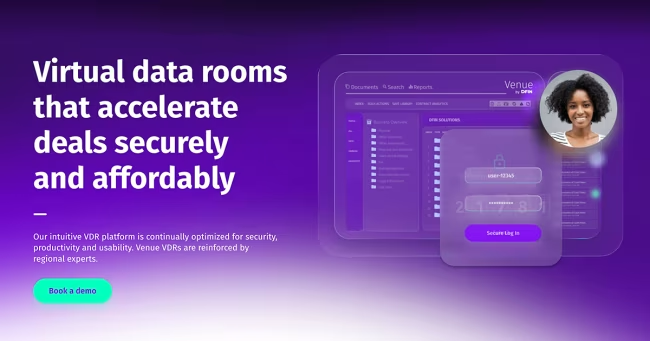
Our Venue virtual data room platform is built specifically for complex capital markets and M&A transactions. It provides secure document collaboration, structured workflows, and robust monitoring capabilities that reduce execution risk. Built for scale and performance, Venue supports high-volume activity without sacrificing speed, reliability, or user experience, even in competitive, multi-bidder processes.
Organizations rely on DFIN as their M&A data room provider because we combine technology with domain expertise. Our teams understand the demands of M&A due diligence, regulatory scrutiny, and capital markets disclosure. We work alongside clients to align platform configuration with transaction strategy, helping anticipate diligence pressure points before they become obstacles.
Venue supports:
- Secure, role-based access controls
- Advanced activity reporting
- Comprehensive audit trail visibility
- Integrated Q&A management
- Scalable infrastructure for global deals
We also offer the ability for teams to explore capabilities through a controlled free trial, allowing organizations to evaluate functionality in advance of a live transaction and confirm alignment with internal governance standards.
From diligence to signing to regulatory filings, our solutions create continuity. Information housed in the data room can seamlessly support downstream disclosures and compliance requirements, reducing duplication and preserving consistency across filings.
An M&A data room is foundational to modern dealmaking. It centralizes disclosure, protects confidential information, and enables structured diligence. But the platform alone is not enough. Successful transactions depend on preparation, governance, and disciplined execution supported by technology designed for regulatory precision.
At DFIN, we support organizations at every stage of the transaction lifecycle. By combining secure technology with deep transaction expertise, we help teams reduce risk, improve transparency, and execute with confidence.
In competitive deal environments, readiness is a differentiator. A well-managed virtual data room ensures your organization is prepared when opportunity arises.