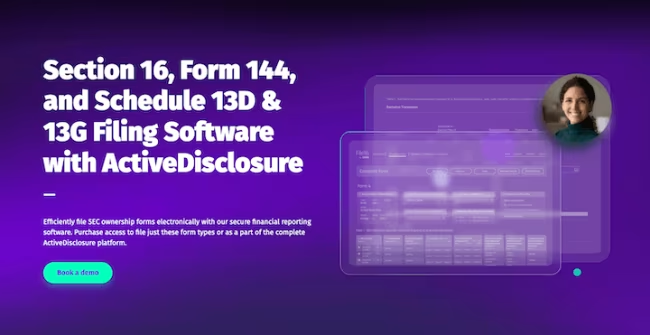
Navigating the complexities of Section 16 reporting software requires understanding the technical, regulatory, and operational challenges that make implementation and ongoing management a formidable undertaking for compliance teams.
The Regulatory Complexity Behind Section 16 Compliance
Section 16 of the Securities Exchange Act of 1934 imposes stringent reporting requirements on corporate insiders, mandating precise disclosure of beneficial ownership changes through Forms 3, 4, and 5. The regulatory framework underlying these insider trading reporting obligations is inherently complex, requiring compliance teams to navigate intricate SEC rules, interpretive guidance, and enforcement precedents that evolve continuously. Public company disclosure compliance demands not only technical knowledge of securities regulations but also a nuanced understanding of beneficial ownership calculations, derivative securities treatment, and exemption applicability—all of which must be reflected accurately in SEC reporting software.
The regulatory burden extends beyond mere form completion. Corporate secretaries and compliance officers must interpret complex fact patterns involving indirect ownership, family attribution rules, and Rule 10b5-1 plan considerations. Each transaction type carries distinct reporting triggers and deadlines, with Form 4 filings typically due within two business days of the triggering event. This compressed timeline leaves minimal margin for error, making the operational demands of Section 16 reporting software particularly acute. Compliance reporting tools must accommodate these regulatory nuances while maintaining the precision and audit trails required by securities authorities, creating a significant technical and interpretive challenge for even the most sophisticated platforms.
Data Integration Challenges Across Multiple Systems
Section 16 reporting software operates at the intersection of multiple enterprise systems, requiring seamless data integration across stock plan administration platforms, payroll systems, equity compensation databases, and corporate records management solutions. The challenge lies not merely in connecting disparate systems but in ensuring data accuracy, consistency, and timeliness across all touchpoints. Insider trading reporting depends on real-time transaction data from transfer agents, brokers, and internal stock plan administrators—each maintaining their own data formats, update frequencies, and security protocols. This fragmentation creates significant operational complexity for compliance teams attempting to maintain a single source of truth for beneficial ownership positions.
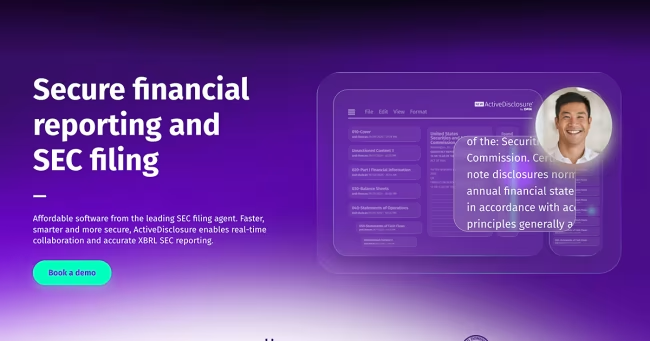
Data quality issues compound these integration challenges. Manual data entry, incomplete transaction records, and reconciliation gaps between systems introduce risk of material misstatements in Section 16 filings. Public company compliance teams must implement robust data validation protocols and exception management workflows to identify discrepancies before they result in late filings or SEC comment letters. The technical infrastructure required to support these data flows—including API integrations, automated data mapping, and real-time synchronization—represents a substantial ongoing investment. Organizations leveraging advanced SEC reporting software like ActiveDisclosure benefit from purpose-built integration capabilities designed specifically for regulatory reporting workflows, reducing the manual effort and error risk associated with multi-system data aggregation.
Technical Infrastructure Requirements and Maintenance Demands
Implementing Section 16 reporting software requires significant technical infrastructure investment, extending well beyond initial licensing costs. Enterprise-grade compliance reporting tools demand robust security architectures, including role-based access controls, multi-factor authentication, encryption protocols, and comprehensive audit logging to protect sensitive insider transaction data. The system must maintain high availability and reliability standards, as filing deadlines are non-negotiable and system downtime during critical reporting windows can result in regulatory violations. Cloud-based SEC reporting software solutions offer advantages in scalability and disaster recovery, but require careful evaluation of data residency requirements, service level agreements, and vendor security certifications.
Ongoing maintenance demands create additional operational burden for compliance teams and IT departments alike. Regulatory technology platforms require regular updates to accommodate SEC rule changes, EDGAR system modifications, and evolving cybersecurity threats. Software version management, testing protocols, and change control procedures must balance the need for current functionality against the risk of introducing errors into production filing environments. Organizations must also maintain technical expertise to troubleshoot system issues, optimize reporting workflow management, and configure platform capabilities to align with their specific organizational structures and reporting requirements. These maintenance demands represent a persistent resource allocation challenge, particularly for mid-sized public companies with constrained compliance budgets and limited technical personnel.
User Training and Adoption Barriers in Enterprise Environments
The sophistication of modern Section 16 reporting software presents significant user adoption challenges within corporate environments. Compliance officers, corporate secretaries, legal counsel, and administrative personnel each interact with the platform differently, requiring role-specific training on system functionality, workflow protocols, and quality control procedures. The learning curve for comprehensive SEC reporting software can be substantial, particularly for organizations transitioning from manual processes or legacy systems. Users must develop proficiency not only in software navigation but also in understanding how platform features map to regulatory requirements—a dual competency that demands sustained training investment and institutional knowledge transfer.
Enterprise adoption barriers extend beyond initial training to encompass change management, process standardization, and organizational alignment. Decentralized compliance functions, where multiple departments maintain responsibility for different aspects of insider reporting, complicate workflow coordination and create potential gaps in accountability. Resistance to new technology, competing priorities, and staff turnover further impede successful implementation and sustained utilization of compliance reporting tools. Organizations achieving successful adoption typically combine comprehensive training programs with executive sponsorship, clear process documentation, and ongoing support structures. Platforms emphasizing intuitive user experience and streamlined workflows—such as ActiveDisclosure's purpose-built interface for financial reporting and attestation—can substantially reduce training requirements and accelerate user proficiency, though the organizational change management dimension remains a critical success factor independent of platform design.
Automation Limitations and Manual Oversight Necessities
While automation represents a compelling value proposition for Section 16 reporting software, significant limitations constrain its practical application in compliance workflows. Automated transaction detection and form population capabilities depend entirely on data quality and completeness from upstream systems—gaps or errors in source data propagate directly into regulatory filings unless identified through manual review. Complex transaction types, including derivative securities exercises, equity award modifications, and restructuring events, often require human judgment to determine proper reporting treatment. The SEC's beneficial ownership rules contain numerous fact-specific nuances that resist pure algorithmic application, necessitating compliance officer review even when initial form preparation is automated.
Manual oversight remains an indispensable component of public company disclosure compliance, regardless of technological sophistication. Experienced compliance professionals provide essential quality assurance by verifying transaction classification, confirming exemption applicability, reviewing footnote disclosures, and validating calculated ownership positions before filing submission. This human validation layer protects against both system errors and edge cases that automated logic fails to accommodate appropriately. The optimal approach combines intelligent automation for routine transactions and data aggregation with structured manual review protocols for complex situations and final filing approval. Reporting workflow management platforms that effectively balance automation efficiency with manual control points—enabling compliance teams to focus expertise where it delivers greatest value—provide the most sustainable operational model. Organizations implementing Section 16 reporting software must therefore design hybrid workflows recognizing that technology augments rather than replaces compliance judgment, maintaining appropriate manual oversight while capturing automation benefits for repetitive, high-volume processes.
For organizations seeking to reduce the operational burden of Section 16 compliance, the value of purpose-built technology lies in its ability to unify data, streamline workflows, and support more consistent oversight across the reporting process. DFIN ActiveDisclosure helps address these demands by providing a structured environment for SEC reporting and attestation workflows, enabling compliance teams to improve efficiency without sacrificing control. In a regulatory landscape where timing, accuracy, and auditability are critical, solutions designed specifically for public company disclosure processes can play an important role in strengthening both compliance readiness and reporting confidence.