Financial reporting teams are expected to deliver accurate, auditable disclosures under increasingly tight deadlines. Yet much of their time is still consumed by work that adds little strategic value. Financial analysts, associates, and even partners spend an estimated 40% to 60% of their week on routine data collection and formatting rather than analysis and decision-making.
For many organizations, the root cause is not a lack of expertise. It's disconnected data. Critical financial information often moves through a series of spreadsheets, exports, imports, reconciliations, and manual validations before it reaches a disclosure or regulatory filing. Every handoff introduces additional effort, creates opportunities for error, and makes it harder to maintain confidence in reported results.
As reporting requirements become more complex and stakeholders demand greater transparency, finance teams need a more efficient approach. That's where connected reporting comes in. By linking trusted source-system data directly to reporting workflows, organizations can spend less time moving information and more time analyzing it.
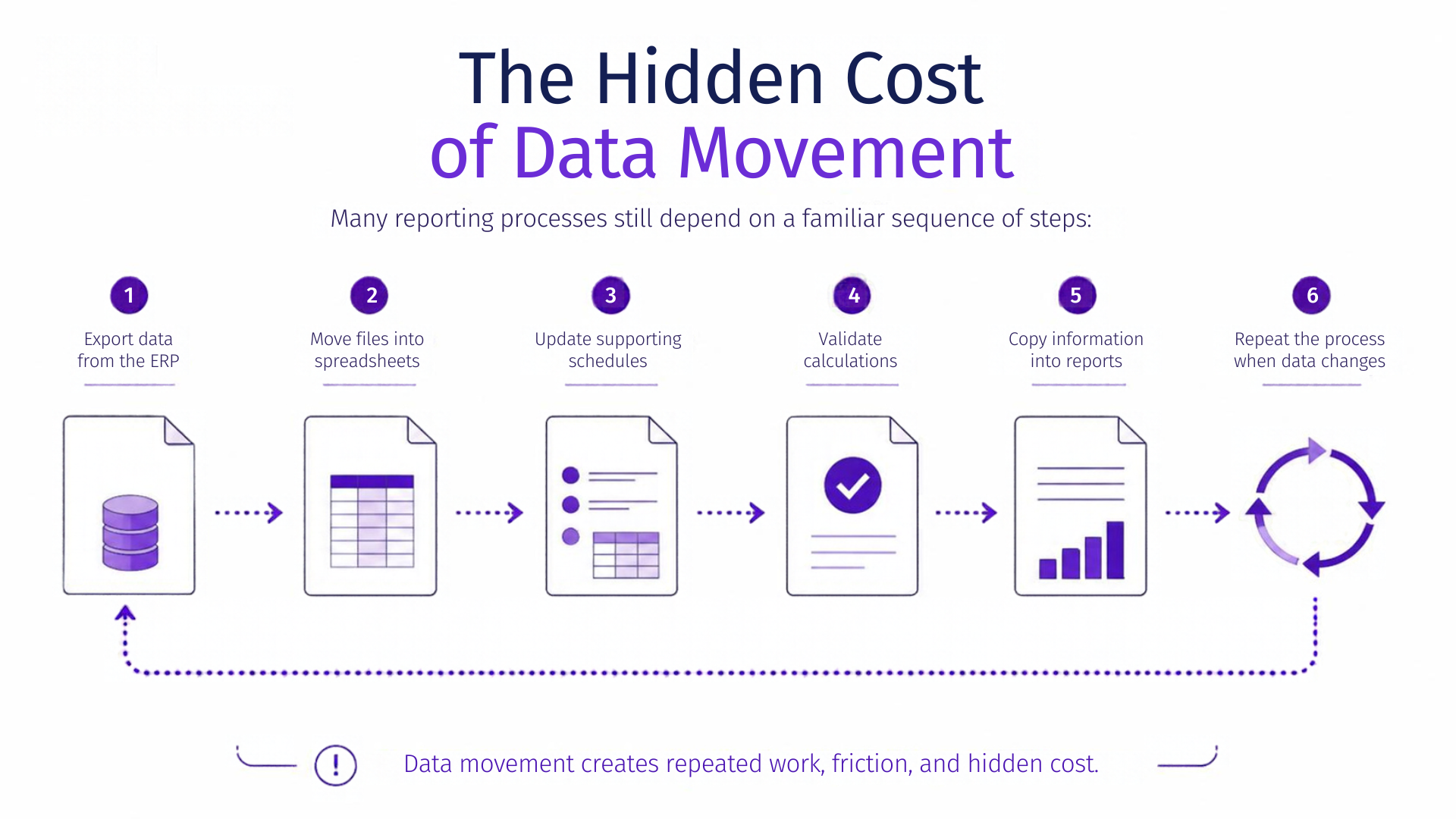
The Hidden Cost of Data Movement
Many reporting processes still depend on a familiar sequence of steps:
- Export data from the ERP
- Move files into spreadsheets
- Update supporting schedules
- Validate calculations
- Copy information into reports
- Repeat the process when data changes
While this workflow may feel manageable, every manual handoff introduces risk. Teams spend valuable time reconciling numbers, confirming they are working from the latest version, and tracing changes across multiple files.
As reporting complexity grows, so does the likelihood of errors, inconsistencies, and inefficiencies. Even when controls are in place, manual processes create unnecessary work that delays reporting cycles and diverts attention away from higher-value analysis.
Finance and reporting teams often find themselves spending more time moving data than interpreting it.
Why Connected Data Matters
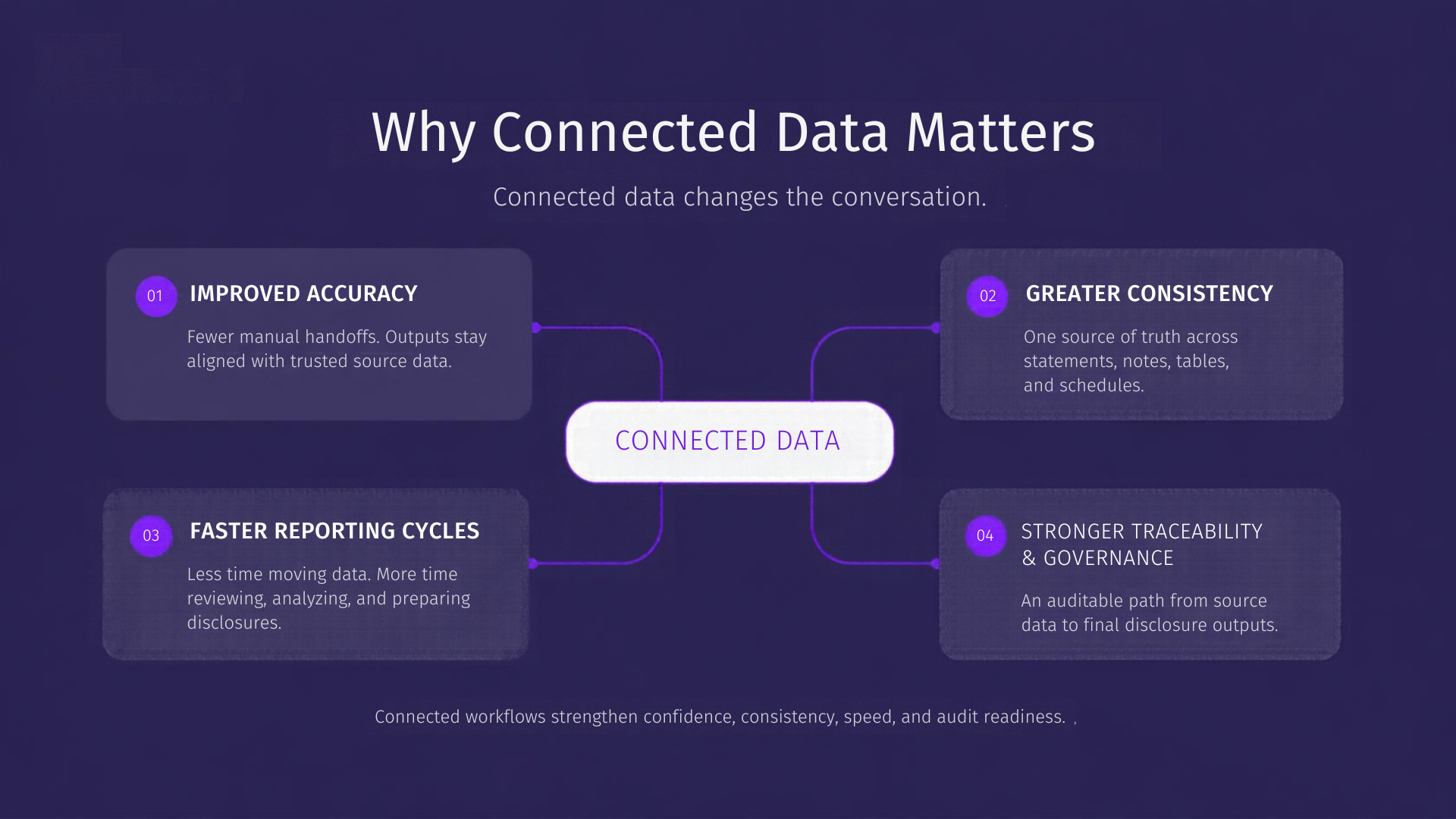
Connected data changes the conversation.
Instead of repeatedly transferring information between systems, organizations can create a direct relationship between source data and downstream reporting activities. When data remains connected, reporting teams gain greater confidence that information appearing in disclosures, financial statements, and supporting schedules reflects the latest available source data.
This approach delivers several important benefits:
Improved Accuracy
When teams reduce manual exports, imports, and spreadsheet-based handoffs, they also reduce opportunities for human error. Connected workflows help ensure that reporting outputs are aligned with trusted source-system data.
Greater Consistency
One of the biggest reporting challenges is maintaining consistency across financial statements, notes, tables, and supporting schedules. Connected data helps establish a single source of truth that can be leveraged throughout the reporting process. When source data changes, teams can update connected datasets rather than manually reworking multiple files.
Faster Reporting Cycles
Reporting deadlines aren't becoming more flexible. Connected workflows help teams access required financial data faster and spend less time performing repetitive administrative tasks. Less time moving data means more time reviewing results, analyzing trends, and preparing disclosures.
Stronger Traceability and Governance
Stakeholders increasingly expect visibility into where reported numbers originated and how they moved through the reporting process. Connected reporting creates an auditable path between source data and final disclosure outputs, helping organizations strengthen governance and support audit readiness.
Connected Reporting Starts with the ERP
For most organizations, critical financial information begins within their ERP system. That's why ERP connectivity is often the first step toward a connected reporting strategy.
The challenge has historically been that ERP systems and disclosure reporting tools operate independently, requiring finance teams to bridge the gap themselves through exports, spreadsheets, and manual processes.
By creating a direct connection between these environments, organizations can eliminate much of the friction that exists between financial close and disclosure reporting. Instead of continuously recreating data flows, reporting teams can work from trusted ERP-sourced information throughout the reporting lifecycle.
Building the Foundation for Modern Reporting
Connected reporting is about more than productivity. It's about positioning finance teams for a future where reporting must be faster, more transparent, and increasingly data-driven.
Organizations that continue relying on disconnected workflows will face growing challenges as data volumes expand and regulatory expectations evolve. Connected data provides a foundation for greater automation, stronger governance, and more scalable reporting processes.
DFIN ActiveDisclosure℠ directly integrates financial data from NetSuite or existing ERPs to help finance and reporting teams establish a more connected reporting process.
This means reporting teams can move from a disconnected process to a more streamlined workflow where ERP-sourced financial data supports reporting activities directly, without abandoning established reporting practices.
Financial reporting teams shouldn't have to choose between speed and accuracy. By connecting trusted source data directly to reporting workflows, organizations can reduce manual processes, improve consistency, strengthen governance, and accelerate the path from financial close to disclosure-ready reporting.