The FCA's long-awaited sustainability reporting framework has arrived.
With the publication of the final UK Sustainability Reporting Standards (UK SRS) rules, UK-listed companies finally have greater certainty about what sustainability reporting will look like over the coming years. The new framework applies to accounting periods beginning on or after 1 January 2027 and adopts a comply-or-explain approach aligned with ISSB standards.
While the FCA has opted for flexibility rather than a fully mandatory regime, the direction of travel is clear. Investors, boards, regulators and assurance providers increasingly expect sustainability information to be reported with the same discipline, governance and transparency as financial disclosures.
For many companies, that means the real challenge is no longer understanding the rules. It is preparing the reporting processes, governance frameworks and disclosure workflows needed to support the first reporting cycle in 2028 and beyond.
The organisations that will be best positioned are those that use 2027 to strengthen reporting infrastructure, improve governance and establish repeatable disclosure processes across teams and reporting frameworks.
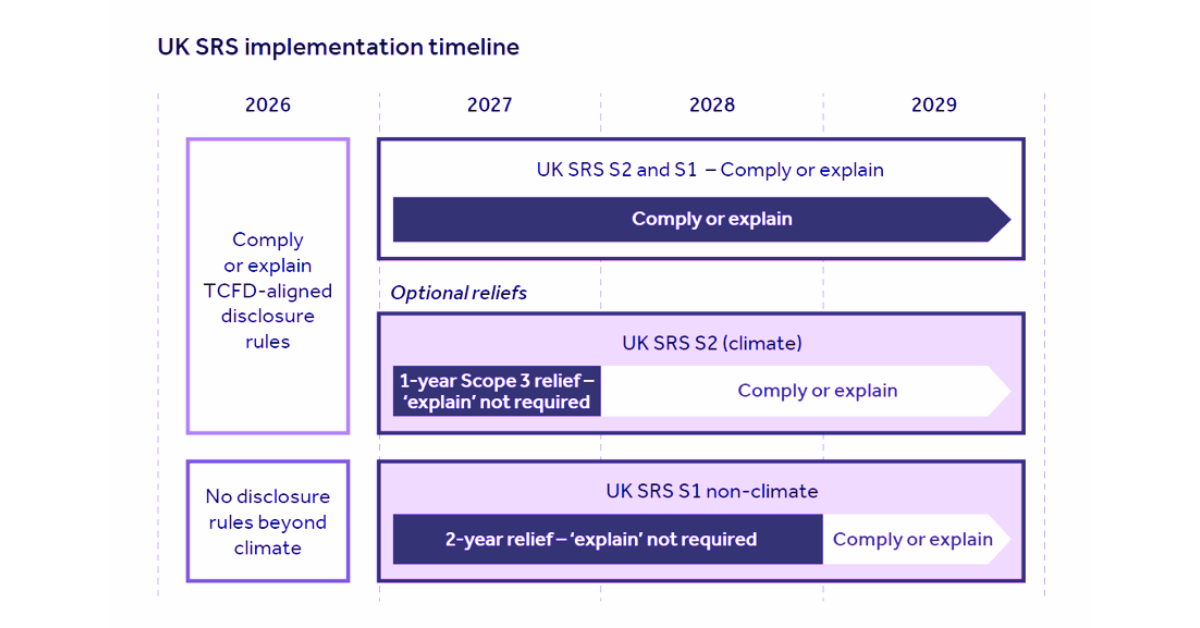
Source: Financial Conduct Authority, PS26/19: Aligning Listed Issuers' Sustainability Disclosures with International Standards , September 2026
What Do the FCA's Final UK SRS Rules Mean for Listed Companies?
The FCA's final rules incorporate UK SRS into the UK Listing Rules and apply to accounting periods beginning on or after 1 January 2027.
The framework aligns closely with the ISSB standards and is intended to improve the consistency, comparability and quality of sustainability disclosures across UK capital markets. Rather than requiring companies to comply with every disclosure immediately, the FCA has adopted a comply-or-explain model, recognising that companies are at different stages of reporting maturity.
That flexibility should be welcomed, but it should not be mistaken for a lighter reporting burden.
Companies that choose not to provide certain disclosures must still explain why, and increasingly those explanations will be scrutinised by investors, regulators and other stakeholders. In practice, reporting teams need to be able to demonstrate not only what has been disclosed, but also how conclusions were reached, how data was gathered and how decisions were governed.
Sustainability Reporting Is Becoming More Closely Integrated with the Annual Reporting Process
One of the most significant implications of UK SRS is that sustainability reporting is becoming more closely integrated with the annual reporting process.
Historically, sustainability disclosures were often prepared separately from statutory reporting. Under the new framework, sustainability information is moving further into mainstream corporate reporting alongside financial disclosures, governance reporting and regulatory filings.
For many organisations, that means sustainability teams can no longer operate independently from finance, legal, investor relations and external advisers. Multiple stakeholders are now expected to contribute to, review and approve sustainability disclosures within the same reporting cycle as financial and regulatory reporting.
The challenge is often less about gathering information and more about managing the reporting process itself. Coordinating contributors, controlling document versions, tracking reviews and maintaining a clear audit trail can quickly become difficult when reporting is managed across disconnected systems and workflows.
As sustainability reporting becomes increasingly connected to annual reporting, organisations are placing greater emphasis on governance, transparency and control. The strength of the reporting process is becoming just as important as the disclosures themselves.
The Rise of Assurance-Ready Reporting
Meanwhile, another key aspect of the FCA's final framework is its focus on assurance transparency. Although external assurance is not currently mandatory, companies will be required to disclose whether assurance has been obtained and provide details about the scope and nature of that assurance.
This reflects a broader trend that is already taking place across global capital markets. Boards and investors are placing greater emphasis on the reliability of sustainability information, while many companies are voluntarily pursuing assurance to strengthen confidence in their disclosures.
The organisations best positioned for future reporting requirements are those building assurance-ready processes now. In practice, that means establishing clear ownership of disclosures, maintaining supporting evidence, documenting methodologies and assumptions, and ensuring information can be traced throughout the reporting cycle.
UK SRS, CSRD and ISSB: Avoid Building Multiple Reporting Silos
For many multinational organisations, UK SRS is unlikely to be the only reporting framework they need to address. Companies may also be managing CSRD, ISSB-based reporting and other sustainability disclosure requirements.
While the frameworks differ, much of the underlying information is often the same. The challenge is not creating separate reports for each requirement, but managing disclosures consistently across multiple frameworks while maintaining governance and control.
As reporting obligations continue to expand, many organisations are looking to streamline reporting through a common workflow rather than building separate processes for every new requirement. This is where a controlled disclosure management environment can help simplify reporting, reduce duplication and bring greater consistency across sustainability and annual reporting programmes.
Strategic Advantage: Building Investor Confidence Through Connected Reporting
The benefits of integrated reporting extend beyond regulatory compliance. Investors increasingly expect sustainability risks, opportunities and performance metrics to be connected to annual reports and broader corporate disclosures rather than presented in isolation.
By aligning sustainability and financial reporting within a consistent governance framework, organisations can provide a clearer view of strategy, risk management and long-term value creation. Combined with structured digital reporting and iXBRL-tagged disclosures, this can improve transparency, comparability and investor confidence across the reporting ecosystem.
Simplifying Sustainability Reporting with ActiveDisclosure
As sustainability reporting becomes more closely integrated with annual reporting, many organisations are looking to avoid fragmented reporting processes and disconnected workflows.
DFIN ActiveDisclosure helps bring sustainability, finance, legal, investor relations and external advisers together within a single controlled reporting environment. Rather than replacing underlying ESG data sources, ActiveDisclosure serves as the reporting and disclosure management layer, helping teams manage reviews, approvals, version control and audit trails more efficiently.
For organisations preparing for UK SRS, ActiveDisclosure can help simplify the management of sustainability disclosures alongside annual reports, UKSEF/ESEF reporting, CSRD, ISSB and other regulatory obligations through a common workflow. As reporting expectations continue to evolve, strong governance, transparency and control are becoming just as important as the disclosures themselves.
Learn More
With the FCA's final UK SRS framework now in place, the focus is shifting from regulatory consultation to practical implementation.
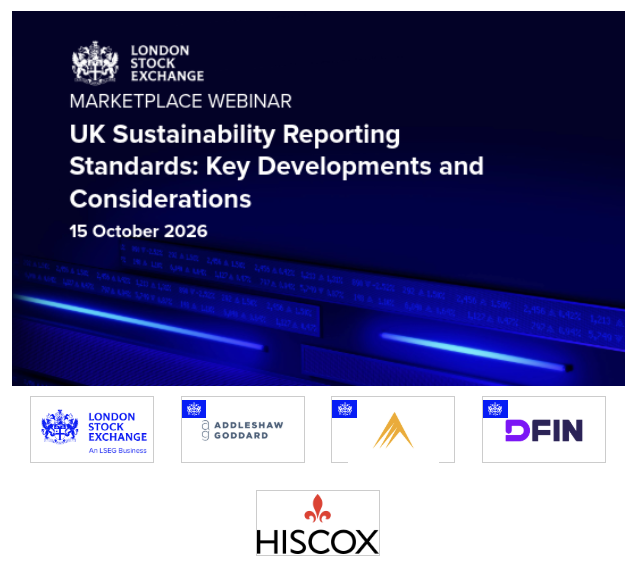
To hear perspectives from London Stock Exchange Group, Addleshaw Goddard, Crowe, Hiscox and DFIN on how organisations are preparing for UK Sustainability Reporting Standards adoption, watch the webinar recorded on 15 October 2026: UK Sustainability Reporting Standards: Key Developments and Considerations
Find out how DFIN can support your sustainability reporting journey:
- Explore our ESG Reporting & Sustainability Disclosure Solutions
- Learn more about ActiveDisclosure
- Request a demo to see how DFIN can help simplify sustainability reporting, disclosure management and annual reporting workflows