An investment memorandum sits at the center of many high-stakes corporate finance transactions, serving as the document that translates a company’s strategy, financial performance, and growth potential into a structured investment narrative for sophisticated stakeholders. Whether used in M&A processes, private capital raises, or strategic investment discussions, the memorandum provides investors, lenders, and acquirers with the information necessary to evaluate both the opportunity and the underlying risks before advancing into deeper diligence.
A well-structured investment memorandum helps organize complex business, operational, and financial information into a format that allows a potential investor to evaluate whether the opportunity warrants deeper diligence and further engagement. Depending on the transaction type, the document may support capital raises, M&A processes, strategic investments, or internal investment approvals.
Although an investment memorandum is not typically filed publicly with regulators, it often supports transactions that may be subject to securities laws, contractual disclosure obligations, diligence requirements, or other legal and regulatory considerations. In practice, the document often becomes one of the most influential materials distributed during a transaction process because it shapes first impressions, frames valuation discussions, and establishes the foundation for subsequent diligence.
Across capital markets transactions, management teams, advisors, lenders, and investors rely on the memorandum to evaluate risk, assess strategic fit, and understand the long-term value proposition underlying the transaction.
Why Investment Memorandums Matter
An investment memo is more than a marketing document. It is a strategic communication tool designed to align financial information, transaction objectives, and operational positioning into a coherent investment narrative.
For issuers, sellers, and advisors, investment memorandums help:
- Present the company’s value proposition clearly and consistently
- Standardize communications with potential investors
- Reduce repetitive diligence requests
- Improve transaction efficiency
- Support more informed discussions with investors and counterparties
For investors and buyers, the document provides an organized framework for evaluating strategic fit, risk exposure, financial quality, and overall return potential. Whether the transaction involves Venture Capital financing, Private Equity investment, or broader M&A deals, stakeholders rely on the memorandum to determine whether additional diligence is warranted.
Institutional investors, lenders, and strategic buyers often evaluate dozens of opportunities simultaneously. A disciplined memorandum helps streamline that evaluation process by presenting a consistent narrative supported by organized financial and operational data. In competitive fundraising or transaction environments, the quality of the document can materially influence whether a prospective investor advances to deeper diligence or deprioritizes the opportunity entirely. This is particularly important in processes involving multiple bidders, compressed timelines, or highly competitive capital markets conditions.
In many cases, the quality of the document influences transaction momentum directly. A poorly organized or inconsistent memorandum can create uncertainty, increase diligence friction, and weaken investor confidence early in the process. Conversely, a disciplined and well-supported memorandum helps establish credibility while improving coordination among legal, finance, management, and advisory teams.
Accuracy is particularly important. Unsupported claims, overly aggressive assumptions, or inconsistent financial projections can undermine trust and create legal or diligence complications later in the transaction lifecycle.
Common Types of Investment Memorandums
The structure and content of an investment memorandum vary depending on the transaction type, investor audience, and regulatory framework involved.
M&A Investment Memorandum or CIM
In M&A transactions, the memorandum, often referred to as a confidential information memorandum or CIM, is used to introduce a company to potential acquirers. These documents typically include a detailed company overview, market positioning analysis, historical financial performance, customer profile, operational footprint, and transaction rationale.
Because buyers use the memorandum to evaluate strategic fit and valuation potential, the document must balance persuasive positioning with factual support and disciplined disclosure practices.
Private Placement Memorandum
A private placement memorandum is commonly used when securities are offered privately under an exemption from public registration requirements. A PPM typically serves as the primary offering document in a private securities offering and generally includes offering terms, risk factors, investor suitability requirements, legal disclosures, and compliance-related information.
Because investors may rely heavily on the document when evaluating the offering, legal review and disclosure accuracy are critical.
Fundraising Memorandum
Private companies raising capital from Venture Capital firms, angel investors, strategic investors, or Private Equity sponsors often prepare a fundraising-focused memorandum emphasizing scalability, market opportunity, growth strategy, customer traction, and capital deployment plans.
These materials frequently focus on operational metrics, unit economics, recurring revenue visibility, and long-term growth assumptions that support the broader investment thesis.
Real Estate Investment Memorandum
Real estate transactions often involve a specialized offering memorandum focused on individual properties or portfolio-level investments. These memorandums typically include asset descriptions, rent rolls, market analysis, financing assumptions, projected returns, and valuation frameworks.
Internal Investment Committee Memorandum
Investment firms and corporate development teams may also prepare internal memorandums designed for an investment committee review process. These documents generally focus on valuation, return expectations, strategic rationale, diligence findings, downside risks, and approval recommendations.
Key Components of an Investment Memorandum
An effective investment memorandum template combines financial analysis, operational insight, and transaction positioning into a structured document that supports informed decision-making.
Executive Summary
The executive summary provides a concise overview of the company, transaction objective, and core investment highlights. This section should quickly explain why the opportunity is compelling and establish the broader narrative supporting the transaction.
Strong summaries typically frame the opportunity around strategic differentiation, growth potential, market positioning, and financial profile.
Company Overview
The company overview explains the organization’s history, operating model, products or services, geographic footprint, leadership structure, and strategic direction. This section should also highlight key milestones, competitive differentiators, and operational scale.
For many investors, the company overview becomes the foundation for understanding how the organization generates value and competes within its sector.
Market and Industry Analysis
The market analysis section evaluates industry conditions, growth trends, competitive dynamics, regulatory considerations, and broader macroeconomic influences.
Investors expect management teams to demonstrate a disciplined understanding of market conditions and explain how the business is positioned relative to peers and competitors. In many cases, this section also supports valuation assumptions and long-term growth expectations.
Investment Thesis
The investment thesis explains why the transaction represents an attractive investment opportunity. This section often highlights factors such as recurring revenue visibility, operating leverage, defensible market position, scalable infrastructure, strategic acquisition potential, or differentiated intellectual property.
An effective thesis is data-supported rather than promotional. Sophisticated investors will evaluate whether claims are supported by operational evidence and historical performance trends.
Financial Performance
This section presents historical revenue, profitability, margins, cash flow generation, operating trends, and key performance indicators. Investors typically evaluate both absolute performance and the consistency of financial execution over time.
Where appropriate, management should also explain unusual items, operational changes, or nonrecurring events affecting historical performance.
Forecasts and Projections
Forward-looking financial projections help investors evaluate expected growth, profitability, liquidity needs, and capital requirements. Assumptions supporting the forecast should be clearly documented and internally consistent.
These sections may include sensitivity analyses around margins, customer growth, pricing assumptions, capital expenditures, or financing needs.
Sophisticated investors also evaluate whether assumptions align with broader industry conditions and peer performance trends. In many transactions, management teams supplement projections with peer benchmarking analysis to demonstrate how operating margins, growth expectations, customer concentration, or capital efficiency compare within the broader competitive landscape. These comparisons can help investors contextualize the company’s positioning while strengthening confidence in the overall investment thesis.
Transaction Structure
The transaction structure outlines the proposed investment amount, valuation framework, security structure, use of proceeds, or acquisition terms. For M&A transactions, this section may also explain process timing, expected diligence milestones, and broader transaction objectives.
Risk Factors
Risk disclosures should address operational, market, financial, regulatory, competitive, and legal considerations relevant to the transaction. Generic disclosures are generally less effective than transaction-specific explanations supported by operational context.
Management Team
Investors frequently place substantial weight on leadership quality and execution capability. The management section should highlight executive experience, governance structure, industry expertise, and operational track record.
Diligence Materials and Appendices
Supporting schedules, contracts, customer information, ownership details, and financial statements are often included as appendices or linked through supporting diligence materials.
How Investment Memorandums Support Due Diligence
The investment memorandum frequently serves as an early reference point for financial due diligence and broader transaction review. Investors, lenders, and acquirers use the document to identify areas requiring deeper analysis and validate management’s claims against supporting evidence.
During diligence, stakeholders commonly test memorandum disclosures against:
- Financial statements
- Customer contracts
- Market data
- Regulatory filings
- Legal agreements
- Operational metrics
- Management interviews
Because diligence teams rely heavily on consistency, discrepancies between the memorandum and supporting materials can create delays, reduce confidence, or increase scrutiny.
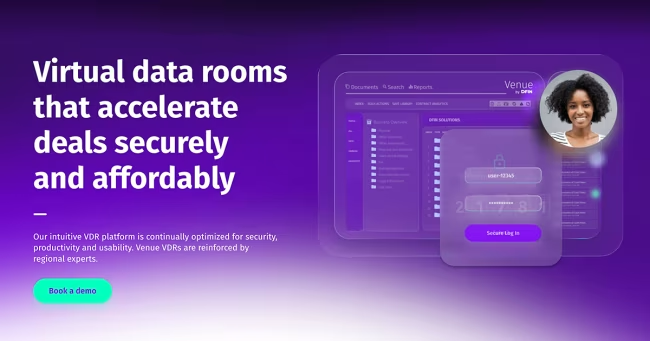
This is where secure virtual data rooms become particularly important. A centralized diligence environment allows companies to organize supporting documentation, maintain version control, and manage permissioned access across multiple stakeholders.
For transaction teams managing complex processes, disciplined document governance is essential. Multiple advisors, executives, legal teams, and bankers often contribute to deal materials simultaneously, making controlled collaboration increasingly important to maintaining consistency across investor-facing documents.
Investment Memorandums in M&A Transactions
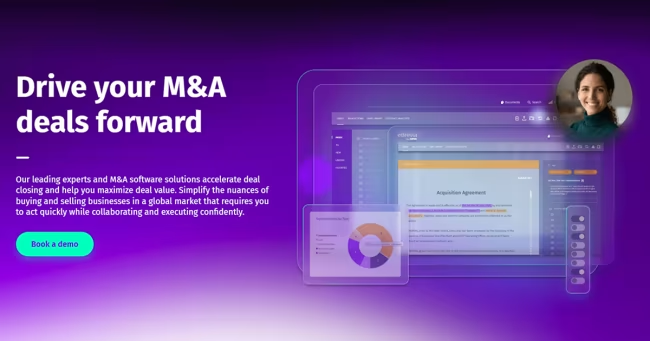
Within M&A processes, the sell-side memorandum is one of the primary tools used to market the target business to prospective buyers.
Typically distributed after execution of a confidentiality agreement, the document provides buyers with the information necessary to evaluate strategic fit, estimate valuation parameters, and determine whether to proceed with additional diligence or management meetings.
Buyers evaluating M&A valuation opportunities generally expect detailed information regarding:
- Historical financial performance
- Revenue concentration
- Customer composition
- Market positioning
- Competitive advantages
- Growth opportunities
- Operational scalability
- Leadership capabilities
Importantly, transaction momentum often depends on the credibility of the information presented. Overly aggressive assumptions, unsupported add-backs, or unrealistic forecasts may create diligence friction later in the process and weaken buyer confidence.
Strong memorandums balance strategic positioning with transparency and disciplined financial presentation.
Investment Memorandums in Private Offerings
In private offerings, the investment memorandum may be used alongside a formal Private Placement Memorandum to explain the issuer’s business model, financing structure, growth strategy, and offering terms to investors evaluating the transaction.
Depending on the transaction structure, companies may prepare materials using an investment memorandum template or broader investment memo template framework designed to support consistency across fundraising discussions and diligence workflows.
Because investors may rely heavily on these materials when evaluating the offering, companies should ensure disclosures are accurate, internally consistent, and reviewed carefully by legal counsel.
Version control is particularly important during private fundraising processes. Changes to assumptions, transaction terms, or financial projections should be tracked carefully, especially when multiple versions of materials are distributed to different investor groups.
Organizations with strong investor relations practices are generally better positioned to maintain consistency across offering materials, diligence discussions, and management communications throughout the fundraising process.
The Role of Technology in Investment Memorandum Preparation
Preparing an investment memorandum often requires collaboration across finance teams, management, legal counsel, investment bankers, consultants, and external advisors. As transaction complexity increases, technology plays a larger role in maintaining consistency, accuracy, and process control.
Modern transaction workflows increasingly rely on technology supporting:
- Secure collaboration
- Version control
- Permissioned document access
- Data linking
- Audit trails
- Review workflows
- Consistency across investor materials
Virtual data rooms help organize diligence materials while providing investors with secure access to supporting documentation tied to the memorandum itself. These platforms also improve visibility into diligence activity and stakeholder engagement throughout the process.
Similarly, financial reporting software can help teams maintain consistency across decks, transaction materials, disclosures, and financial schedules by linking source data and reducing manual update risk.
As transaction activity becomes increasingly data-intensive, organizations are also incorporating more advanced analytics capabilities into diligence and transaction preparation workflows.
Emerging applications involving predictive analytics in corporate finance are helping organizations identify operational trends, evaluate performance assumptions, and strengthen forecasting visibility during transaction planning. These capabilities can improve decision-making quality while helping management teams support more data-driven discussions with investors, lenders, and advisors.
At DFIN, solutions such as Venue and ActiveDisclosure help organizations streamline transaction collaboration, maintain controlled workflows, and improve consistency across deal materials. As transaction scrutiny continues to increase across capital markets, organizations benefit from infrastructure capable of supporting both operational efficiency and disclosure discipline.
The most effective memorandums combine strong strategic positioning with disciplined financial presentation, controlled collaboration, and accurate supporting data. In competitive transaction environments, these factors often play a meaningful role in shaping investor confidence, diligence efficiency, and overall execution success.